
Online vs In-Person Coaching: When Each Wins
Online vs in-person coaching for fitness, nutrition, and mindset. When each wins, when each loses. From a CFL3 coach in Belltown, Seattle.

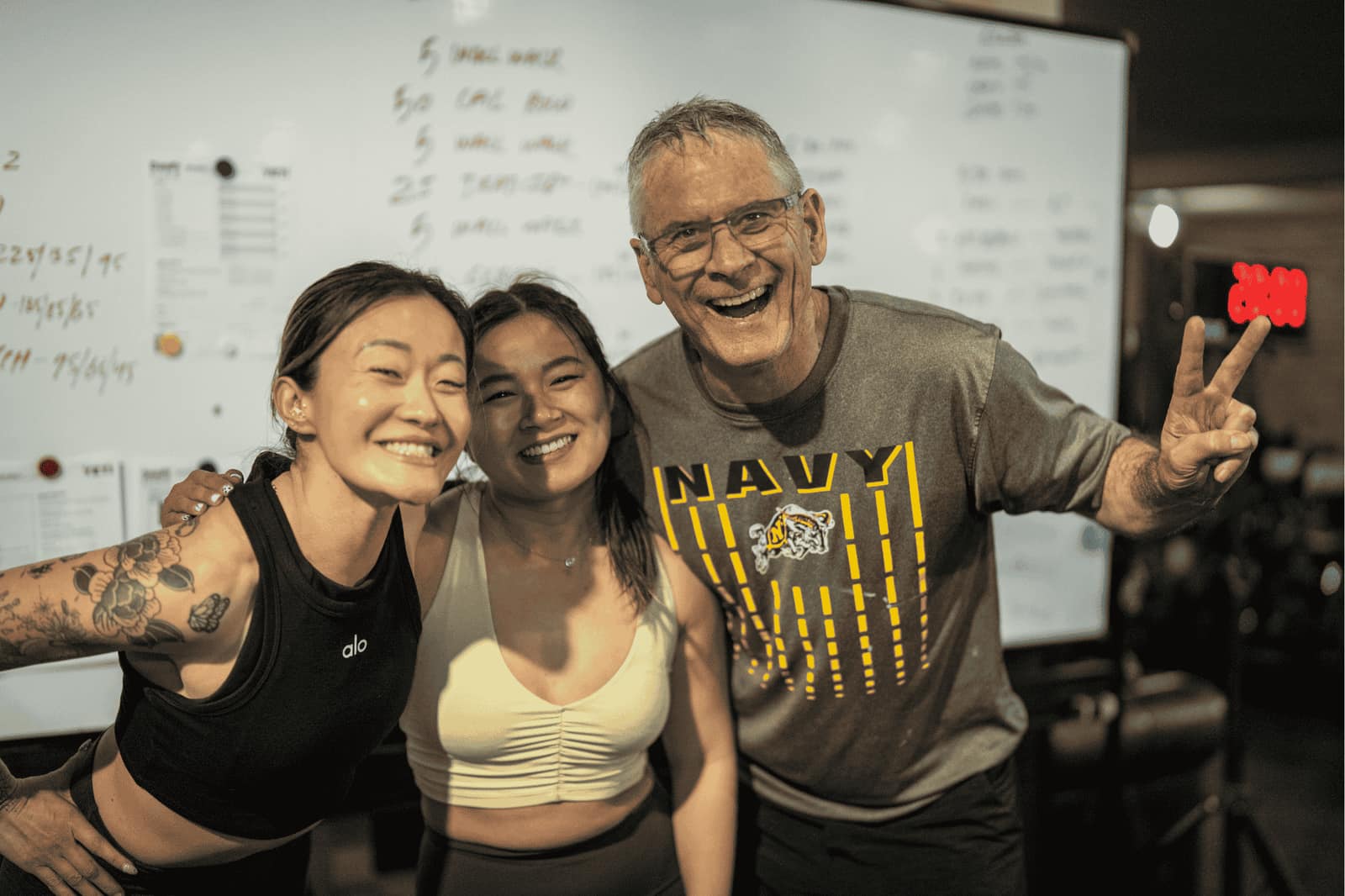
Online coaching has gotten good. In-person coaching has not gotten worse.
The fitness industry's biggest shift in the last five years is the rise of remote coaching as a credible product. Real coaches with real credentials offer remote programming, nutrition coaching, and accountability through apps and video. The quality range is wide, but the top of the market is now legitimate.
That has not made in-person coaching obsolete. The two formats win in different contexts and the choice is more situational than people assume.
This post is the comparison framework I use when prospective members ask about it. We do mostly in-person work at Persistence Athletics in Belltown, but I am realistic about which goals are well-served by online and which are not. I'm Jacque Dewangan, CFL3 and Precision Nutrition Level 2, head coach. Updated June 2026.
Table of Contents
- The full side-by-side comparison
- When online coaching wins
- When in-person coaching wins
- The hybrid model: online + in-person
- Why we run mostly in-person at Persistence
- Frequently Asked Questions
The full side-by-side comparison
Here is the breakdown across the dimensions members care about.
| Dimension | Online coaching | In-person coaching |
|---|---|---|
| Cost per month | $150 to $400 | $640 to $1200 (2x/week PT) |
| Real-time form correction | Limited (video review with delay) | Excellent (every rep watched) |
| Schedule flexibility | High (asynchronous check-ins) | Moderate (set appointments) |
| Programming customization | High (same as in-person) | High |
| Accountability | Moderate (depends on coach contact frequency) | Strong (coach physically waiting) |
| Community | Low to moderate (online groups, sometimes) | High (consistent gym faces) |
| Geographic flexibility | Anywhere | Local only |
| Best fit goals | Habit work, nutrition, mindset, autonomous training | Technique, complex pain, accountability, community |
| Coaching depth on lift technique | 40 to 60% of in-person | 100% |
| Coaching depth on nutrition | 80 to 90% of in-person | 100% |
| Coaching depth on mindset | 80 to 95% of in-person | 100% |
The pattern in the table: online closes the gap for behavior-based work and trails substantially for technique-based work. The right choice depends on what you are buying.
When online coaching wins
1. Geographic constraint
You do not live near a credentialed coach. The nearest CFL3 or comparable coach is 90 minutes away. Online coaching with a coach you would not otherwise have access to is straightforwardly the right call.
2. Schedule that does not fit in-person
Shift work, frequent travel, unpredictable hours. Standing PT appointments will not work. Online with asynchronous check-ins fits the schedule.
3. Autonomous experienced trainee
You have 5+ years of training, your technique is dialed, you do not need someone watching every rep. What you need is programming and accountability. Online coaching delivers both at a fraction of the in-person cost, with no coaching depth penalty for your specific case.
4. Behavior-based work (nutrition, mindset, sleep)
The transfer from in-person to online for these is small. A nutrition coach reviewing your food log via app is roughly as effective as a nutrition coach reviewing it across a table. The same is largely true for mindset coaching and sleep coaching. The behavioral data does not lose much fidelity in the remote setting.
For these four cases, online is the right call. The cost saving is real and the coaching depth penalty is small.
When in-person coaching wins
1. Technique work on the lifts and gymnastics
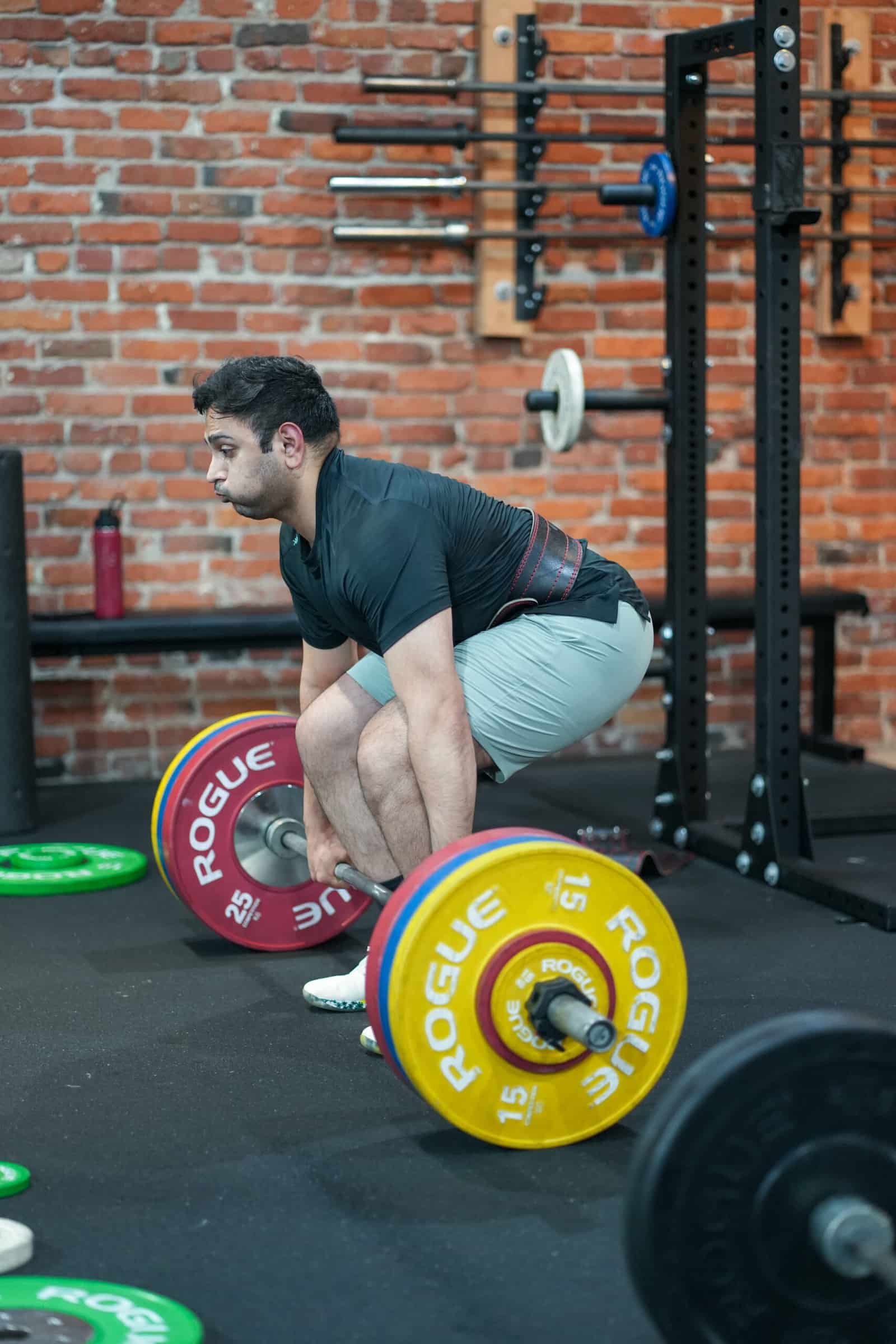
This is the case where the gap is largest. A coach watching every rep on the back squat catches a knee cave or a back round in real time. A coach reviewing video of the same lift sees it 24 to 48 hours later, after the lifter has done 20 more reps with the same fault.
I think about Katie here. She has been with us for years and her gymnastics progression, strict pull-ups into clean ring work, did not come from a video review queue. It came from a coach standing two feet away saying "ribs down, pull the bar to your collarbone, again" on the rep that was about to go wrong. Catch the fault on rep three, not rep thirty. That is the whole game on skill work, and you cannot do it on a 24-hour delay.
The faster the feedback loop, the faster the correction. In-person feedback loops are seconds. Video feedback loops are days. For new lifters, intermediate lifters working on technique, or anyone refining a complex movement (snatch, muscle-up, handstand), in-person wins decisively.
2. Accountability for members who struggle to show up
Some people will not show up without a coach physically waiting for them. They will not log into the app. They will not film the lift. They will not respond to the check-in. The accountability mechanism that works for them is the standing 6:30 PM appointment with a human in a building.
If you are this person, online coaching will fail you. Not because the coach is bad. Because the format does not match your accountability needs.
3. Community
A coached gym is partially a fitness product and partially a community product. The same faces, the same coach, the post-class conversation, the leaderboard, the check-in at the front desk. Online coaching can produce decent online communities (some of the better remote coaches build real ones) but the texture is different.
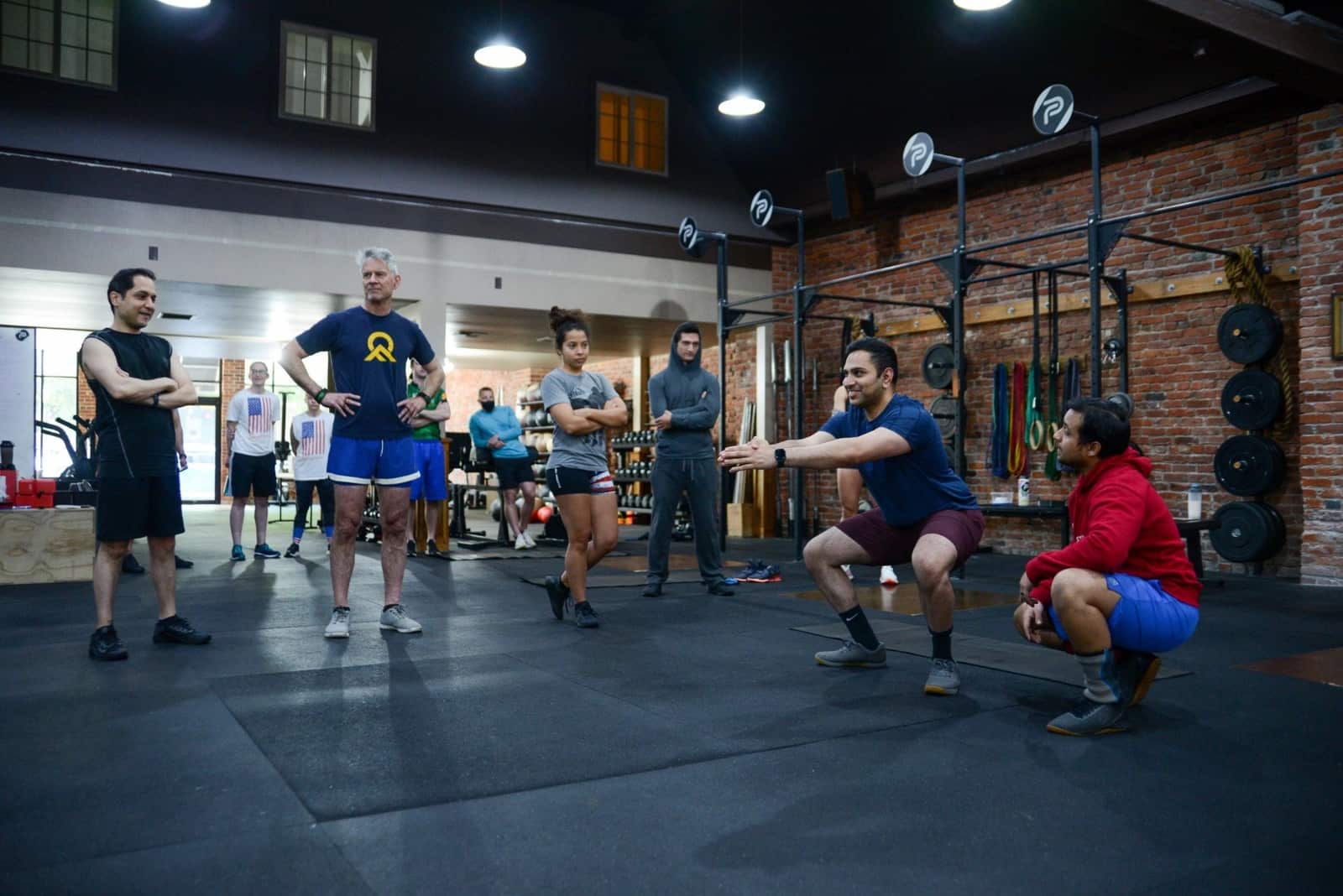
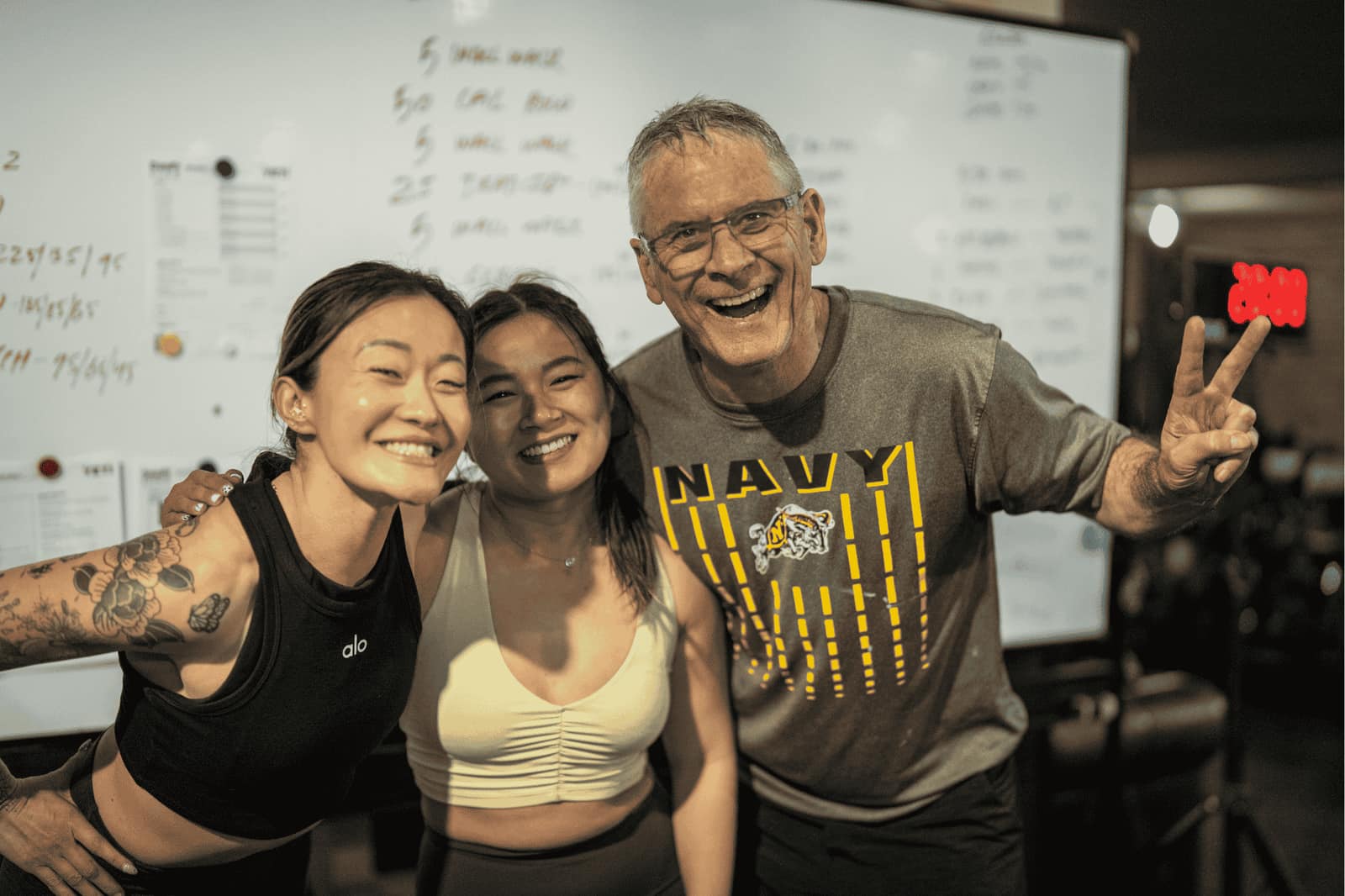
Pouria has trained with us for more than six years and has stacked up around 1,100 classes. Ask him what kept him coming back that long and it is not a clever app push notification. It is the people standing next to him at the 6:30 PM class, the Saturday HYROX crew, the coach who notices when he is off. That texture does not transfer to a screen. If community is part of what you are buying, in-person is the right call.
The hybrid model: online + in-person
The model an increasing number of our members run is hybrid. In-person group classes for the bulk of the week, plus an online programming or nutrition track for the customized work.
A typical hybrid week:
- 3 to 4 in-person group classes (community, conditioning, technique cues from the floor coach)
- 1 to 2 online programming check-ins or weekly nutrition reviews
- No standing PT appointment
The cost is the group membership plus the online or nutrition track. Less than full in-person PT, more than online alone, with most of the upside of both. If you want the format up close before you commit to anything, your first class is free and scaled to wherever you are starting.
This is a reasonable middle ground for members whose schedule is too unpredictable for regular PT but who still want coached structure. Devang, a software engineer who went from beginner to advanced strength over 700-plus classes with us, is a good template for the kind of member it suits: someone who shows up to class for the technique and the room, then wants a customized track layered on top. About 10 to 15% of our members run something like this.
The constraint: the in-person and online coaches need to be aware of each other. If they are running independent programs, the volume can stack and produce overtraining. The simpler version is when both live under one roof, for example group classes at Persistence plus our own nutrition coaching, which I run as a Precision Nutrition Level 2 coach so the food work and the floor work stay in sync.
Why we run mostly in-person at Persistence
Persistence Athletics is mostly an in-person gym. Group classes, personal training, semi-private training. We have done some online coaching for nutrition and for members who relocated, but the core product is the floor.
The reason is straightforward: most of what we coach (CrossFit movements, Olympic lifting, HYROX prep, postpartum return, chronic pain reintegration) is technique-driven and benefits from the in-person feedback loop. Take Sofi, who came back to training postpartum. The early weeks were not about a program a screen could send her. They were about a coach reading how her body moved that day, where to scale, when to add load and when to hold. With a coach-to-athlete ratio of roughly 1 to 12, there is always an eye on that. The cost saving of online for these goals does not offset the coaching depth penalty. We tell members this honestly. If your goal is well-served by online, we will recommend a remote coach we trust before signing you up for in-person work you do not need.
For personal training, the in-person engagement page covers what to expect. The full coach roster and credentials are on the coaches page. For more on the gym's philosophy and what we are trying to build, see about.
The honest test for any prospective member: would your goal be best served by in-person, online, or hybrid? Work backwards from that question. Choose the format that fits. The format that works is more important than the format that is fashionable.
Frequently Asked Questions
Is online coaching as effective as in-person coaching?
It depends on the goal. For habit-based work (nutrition, sleep, mindset), online coaching is roughly 80 to 90% as effective as in-person. For skill-based work (lift technique, gymnastics, sport-specific movement), online drops to 40 to 60%. The difference is the coach's ability to see and correct movement in real time. If your goal is technique-driven, in-person wins decisively. If your goal is behavior-driven, the gap narrows substantially.
How much does online coaching cost vs in-person?
Online coaching for fitness or nutrition typically runs $150 to $400 per month. In-person personal training in Belltown runs $80 to $150 per session ($640 to $1200 per month for twice weekly). Online is roughly 25 to 50% the cost of in-person for similar coaching depth. Online wins on cost. Whether the cost difference is worth the coaching difference depends on the goal.
When does online coaching win?
Four cases. First, geographic: you do not live near a credentialed coach. Second, schedule: shift work or travel makes in-person impossible. Third, autonomy: you are an experienced trainee who needs programming, not technique correction. Fourth, nutrition or mindset: behavior-based work transfers well to remote coaching. For these cases, online is the right call.
When does in-person coaching win?
Four cases. First, technique work: any lift or gymnastics skill you have not mastered. Second, accountability: you struggle to show up without a coach physically present. Third, community: training in a coached gym with consistent peers is part of the value. Fourth, complex pain or injury: real-time movement correction matters and is hard to replicate via video. For these cases, in-person is the right call.
Can I combine online and in-person coaching?
Yes, and this is increasingly common. The hybrid model is in-person group classes 3 to 4 times a week (community, conditioning, technique) plus an online programming or nutrition track for the customized work. This is a reasonable middle ground for members whose schedule is too unpredictable for regular PT but who still want coached structure. About 10 to 15% of our members at Persistence run something like this.
What questions should I ask an online coach before signing up?
Five questions. First, what is your highest cert and most recent CEU? Second, how often do we communicate (daily check-ins, weekly review, etc.)? Third, what does the typical first 12 weeks look like for someone like me? Fourth, can I see a sample weekly program? Fifth, what is the cancellation policy? Vague answers are red flags. The same standards apply to online coaches as in-person.
Try a free first class at Persistence Athletics
If you want to evaluate whether in-person coaching is the right fit for your goal, the free first class is the place to start. A CFL3 coach will walk through your goal, your schedule, and recommend the format that actually fits. We will tell you honestly if online is a better call. Book your free class at Persistence Athletics, 3025 1st Ave, Belltown, Seattle. 8 minutes from Amazon, walkable from anywhere downtown. Questions first? Call us at (206) 593-4236.
Want to take this further?
Talk to a coach about coaching programming at Persistence Athletics.