
Coach Spotlight: A Day With Ravi at Persistence Athletics
Behind the scenes day with Ravi Dewangan, CFL3 head S&C coach at Persistence Athletics, Belltown Seattle. Programming, coaching, training, family.


A coach is what you do every day, not what you post online.
This is the actual day. A Tuesday in 2026. The schedule below is real. The blocks are real. The training is real. The family time is real. I'm Ravi Dewangan, CFL3, MS Strength and Conditioning, and CrossFit Seminar Staff. Head S&C coach at Persistence Athletics in Belltown, Seattle.
This post exists because the most common question I get from prospective members is some version of "what do you actually do all day?" and the most common assumption is wrong. A working CrossFit coach does not look like an Instagram coach. The work is denser, less glamorous, and produces more results. This is what one day looks like, why the schedule produces the outcomes our members get, and why I would not run the gym any other way. Updated June 2026.
Table of Contents

- 5:00 AM: programming review and the day's setup
- 6:00 AM and 7:00 AM: the morning coaching block
- 8:00 AM to 11:00 AM: personal training and admin
- 12:00 PM to 1:30 PM: my own training
- 2:00 PM to 4:00 PM: programming write, member follow-up, intake calls
- 4:00 PM to 7:00 PM: evening coaching block
- 7:00 PM onward: family
- Why this schedule beats the influencer model
- Frequently Asked Questions
5:00 AM: programming review and the day's setup
Alarm at 4:50 AM. Coffee by 5:00 AM. Phone off until 6:30 AM. The first hour of the day is for programming review and the gym's prep, not communication.
Programming review means looking at today's group class workout, today's PT clients' programs, and reviewing the previous day's notes. Every PT session at Persistence ends with a coach note: how the session went, what the load was, what the next session needs. By 5:30 AM I have read the notes from yesterday, adjusted today's programs where needed, and planned the cues I want to emphasize in the morning group class.
If a member's lift looked off in their last group class, I will pre-write a note for the morning coach to focus on a specific cue. If a PT client is approaching a PR test, I have already pre-loaded the warm-up sequence in the program. The work that looks like real-time coaching at 6 AM is mostly pre-staged in the hour before.
Walk to the gym at 5:45 AM. Belltown is empty at that hour. Quiet. The 1st Ave block outside 3025 is still dark. The gym opens at 6 AM and members start arriving at 5:50 AM.
6:00 AM and 7:00 AM: the morning coaching block
The 6 AM and 7 AM group classes are the highest-attendance classes of the day. Tech workers from Amazon, Google, F5, and the surrounding downtown employers come in before they head into the office. Amazon is an 8-minute walk, so a chunk of the 6 AM room is people who will be at their desks by 7:30. The energy is sharp. The volume is high.
I coach both classes most weekdays. The 6 AM is a 60-minute group class. The 7 AM is the same workout, different group, different scaling needs.
A coached group class is not a workout video. It is six things happening at once:
- Watching every member's lift form during the strength portion.
- Scaling the workout for the four to six members who need modifications.
- Cueing the technical position for whichever lift is in the day's strength.
- Managing the class flow (warm-up, lift, metcon, cool-down) on the clock.
- Picking up the member who is having a quiet bad day and just needs eye contact.
- Running the post-class log and answering questions about scaling, soreness, programming.
At a coach-to-athlete ratio of roughly 1 to 12, that math actually works. By the end of the 7 AM class, I have coached roughly 30 members across two hours. Three or four of them have asked me a question I will follow up on later in the day. Two or three of them have hit a small PR I will note in their file.
This is the coaching block where most of the work gets done. It is also the block that wears coaches out fastest. The intensity is real.
8:00 AM to 11:00 AM: personal training and admin
The 8 AM and 9 AM hours are PT slots. Two members, back to back, hour-long sessions. The PT roster I run is heavily weighted toward advanced lifters and plateau-breaking. The two clients on a typical Tuesday morning:
- 8 AM: advanced lifter in a 12-week block periodization cycle, working through an intensification phase.
- 9 AM: masters competitor preparing for a sanctioned meet, doing technique work on the snatch.
This is the kind of work that compounds slowly. Devang is a good illustration of why I protect these hours. He came in as a software engineer with almost no barbell background and now, 724 classes later, he moves like an advanced lifter. None of that arc happens in a single session. It happens because somebody watched the same setup error week after week until it stopped showing up.
Each PT session is 60 minutes of focused 1-on-1. Different from group coaching. The depth of attention is the entire product. Every rep gets watched. Every cue is calibrated. Every load is decided in real time based on what the bar speed and the member's body language tell me.
10 AM is the admin hour. Email, SMS, GHL pipeline review, inbound free trial requests, return-call list. Most of this is run on my phone in 20-minute focused blocks. I do not do email continuously. I do not check Slack continuously. The work gets done in batched chunks because that is what produces the actual output.
11 AM is intake calls. Roughly 5 to 8 minute conversations with prospective members who have submitted a free trial request. The call is not a sales call. It is a 5-minute fit assessment: what is your goal, what is your training history, what is your schedule, are we the right gym for you, who is the right coach for you. About 70% of these calls end in a booked first class. The other 30% are referred elsewhere if we are not the right fit. Telling someone they should go to a different gym is not unusual on these calls. If you want that same fit conversation, you can book a free class and we will sort out the right coach for your goals.
If the goal that comes up on the call is nutrition or a return to training after a break, I usually route the person to Jacque, who holds Precision Nutrition Level 2 and runs our nutrition coaching. Matching by goal on the first phone call saves everyone months.
12:00 PM to 1:30 PM: my own training
The protected block. Non-negotiable. 12 PM to 1:30 PM, every weekday, my own training.
Today's session: heavy back squat. 5 sets of 3 at 365 lb, then accessory work (split squats, glute-ham raise, sled push for legs). The block I am in is HYROX-specific because I have a fall race myself. Tomorrow will be a 6-mile run. Thursday will be deadlift. Friday will be a HYROX simulation, which is the same format members get in our Saturday HYROX class at 9:30 AM.
Current numbers, since people ask: 510 lb deadlift, 405 lb back squat, 285 lb bench, 90-minute HYROX time. Not elite. Coach-grade.
The reason this block is protected is simple. A coach who does not train cannot coach lifters credibly. The body sense, the bar feel, the under-fatigue judgment, the actual experience of running a 1K at 5-minute pace in a HYROX simulation, all of it informs the coaching. If I stop training, my coaching gets worse within a year. I have seen coaches who stopped training. I do not want to be one.
The training also keeps me sane. The 5 AM to 7 PM coaching schedule is dense. The 90-minute training block is the part of the day where nobody is asking me anything. It resets the system.
2:00 PM to 4:00 PM: programming write, member follow-up, intake calls
The 2 PM to 4 PM block is programming and follow-up. The two-hour window after training is when I write programs.
A typical PT client gets a 4-week programming cycle written in advance. I write three to four cycles a week (one per active PT client coming up on a renewal). Each cycle takes 30 to 45 minutes to write properly. I do not template. The programs are individualized.
The block also includes member follow-up. Phone calls or in-person conversations with members who had a question I did not get to in the morning. Usually 2 to 3 of these a day. Sometimes a member needs a longer conversation about a plateau, a goal change, a life change that is affecting their training. Katie's strict pull-up and ring work did not come from a generic accessory list, it came from these follow-up conversations turning into a deliberate gymnastics progression over a couple of hundred classes. Those happen here.
Final intake calls if any are scheduled. Final email and SMS sweep before the evening block.
4:00 PM to 7:00 PM: evening coaching block
Three more group classes. 4:30 PM, 5:30 PM, 6:30 PM. The afternoon and evening waves of members. Different demographic mix than the morning: more freelancers and remote workers at 4:30 PM, full evening rush at 5:30 PM and 6:30 PM.
Same coaching commitment as the morning. Watch every lift. Scale every workout. Cue the technical positions. Catch the quiet member. Run the clock. On the floor with me most of the week is AJ and the rest of the crew, so the evening room is never short on eyes.
By the end of the 6:30 PM class, I have coached close to 60 members across the day, run two PT sessions, written 1 to 2 programming cycles, taken 2 to 3 intake calls, and trained myself.
By the last class of the night the energy is different than at the start. Coaching is real labor.
7:00 PM onward: family
Home by 7:15 PM. Dinner with Jacque (also a coach, also CFL3, Precision Nutrition Level 2, also at the gym most days) and the rest of the family. No phone at the table. Conversation about the day, about the kids, about anything but the gym.
Bed by 9:30 PM. Up at 4:50 AM tomorrow.
The family block is the load-bearing wall of the schedule. Without it, everything else falls apart within a year. A coach who does not protect a block of time for family will burn out and start coaching badly. The work depends on the rest.
Why this schedule beats the influencer model
There is a different model of being a CrossFit coach that I will name and contrast.
The influencer model: spend most of the day producing content. Reels, posts, podcasts, sponsored gear, online programs sold to thousands of strangers. Coach occasionally for camera. Build a brand. The brand is the product.
The working coach model: spend most of the day coaching members in real time. Write individualized programs. Maintain your own training. Tell hard truths to the people on your floor. Build a gym. The members are the product.
Both models can work financially. Only the working coach model produces what our members come here for: Katie's strict pull-up after a patient gymnastics progression, Devang's arc from beginner to advanced, Pouria showing up roughly 1,100 times over six-plus years, Eric going from chronic back pain to strict pull-ups, a HYROX finish under 90 minutes. Those outcomes require the unsexy 5 AM to 7 PM rhythm.
The reason I am writing this post is not because the schedule is exceptional. The schedule is unremarkable. It is what coaching at a real gym looks like. The reason it is worth writing is because the contrast with the influencer model has gotten so loud that prospective members are sometimes confused about what they are actually buying.
If you join Persistence Athletics, you are not buying a brand. You are buying coached time on the floor with coaches who train, who program, who watch every rep, and who go home to their families at 7 PM.
For the coach roster and credentials, see /coaches/ravi-dewangan and the broader about page. For group classes, the schedule and program structure is here. For personal training (most of my PT slots), the page covers fit and engagement.

Frequently Asked Questions
What does a typical day look like for a CrossFit coach in Seattle?
For a head coach running a coached gym, the day starts before 5 AM with programming review, runs through coached classes (typically 2 to 4 sessions a day), includes a personal training block, an admin block, the coach's own training, and ends with family in the evening. The schedule is dense but sustainable when structured around coaching peaks. Total in-gym time is roughly 9 to 11 hours, of which 5 to 7 hours is direct coaching.
How does Ravi train for himself while coaching full-time?
One protected training block in the middle of the day, between the morning coaching peak and the evening peak. Typically 60 to 90 minutes from noon to 1:30 PM. Programming is a hybrid of strength, CrossFit, and HYROX-specific work depending on what is in the cycle. Current PRs include a 510 lb deadlift, 405 lb back squat, 90-minute HYROX time. The training is treated as non-negotiable.
Why does this schedule beat the influencer coaching model?
An influencer coach optimizes for social media output. A working coach optimizes for member outcomes. The 5 AM to 7 PM schedule with multiple coached blocks per day is what consistent member progress requires. It is not glamorous and it does not generate viral content, but it is what produces the strict pull-ups, the deadlift PRs, and the HYROX finishes that are the actual product of a real gym.
How long has Ravi been coaching at Persistence Athletics?
Persistence Athletics opened its doors over a decade ago and Ravi has been on the floor every season since. His credentials accumulated alongside the gym: CFL1 first, then CFL2, then CFL3, then MS Strength and Conditioning, then CrossFit Seminar Staff. Most of the senior credentialing came after years of coaching, not before. The credential pattern reflects the practice.
What is Ravi's coaching specialty?
Programming, advanced lifters, plateau diagnosis, and complex strength cases. He runs the strength side of the gym, writes the block periodization templates, and handles most of the 1-on-1 work with members training for sport (HYROX qualifiers, masters competitions, CrossFit Open). For general fitness and beginner work, Jacque is usually the better fit. The match is by goal, not by ego.
Can I work with Ravi as a personal training client?
Yes, with limits. Most of Ravi's PT slots go to advanced lifters, plateau-breaking, and sport prep blocks. New members starting from scratch are generally better served by Jacque or another coach. If you have a specific lifting goal, a stalled lift, or a sport-specific timeline, his roster has openings. Booking starts with a free first class and an intake conversation about goals.
Try a free first class at Persistence Athletics
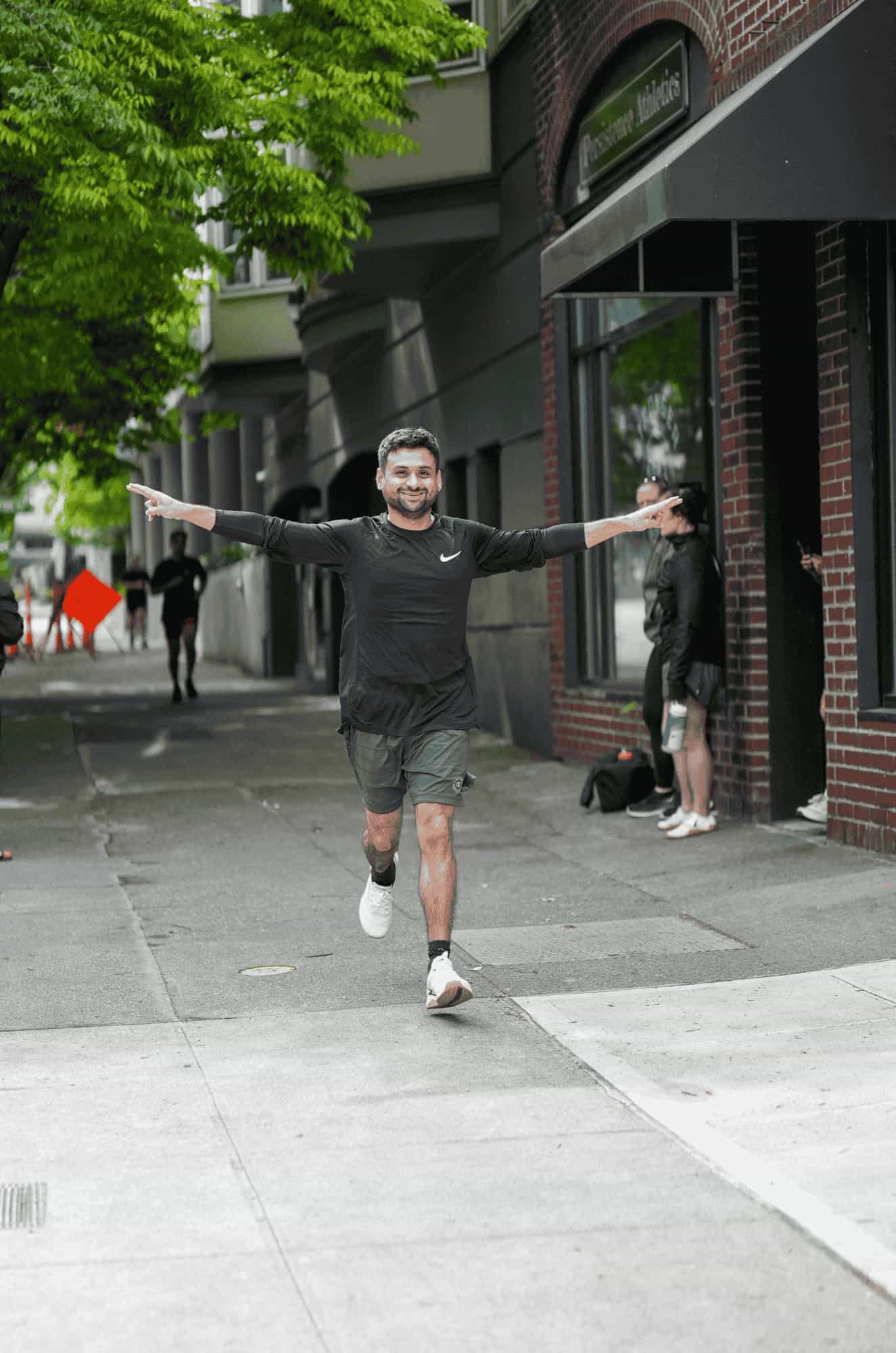
If you want to see the working coach model in person, your first class is free and scaled to wherever you are. You will see the 6 AM or 4:30 PM coaching block live, get a movement screen, and find out which coach is the right fit for your goals. No sales pitch. Book your free class at Persistence Athletics, 3025 1st Ave, Belltown, Seattle. 8 minutes from Amazon, walkable from anywhere downtown. Questions first? Call (206) 593-4236.
Want to take this further?
Talk to a coach about community programming at Persistence Athletics.