
How CrossFit Programming Actually Works (and Ours)
How CrossFit programming actually works. Periodization models, sample week from a Belltown box, why 'random' is a myth. From a CFL3 head coach with MS S&C.

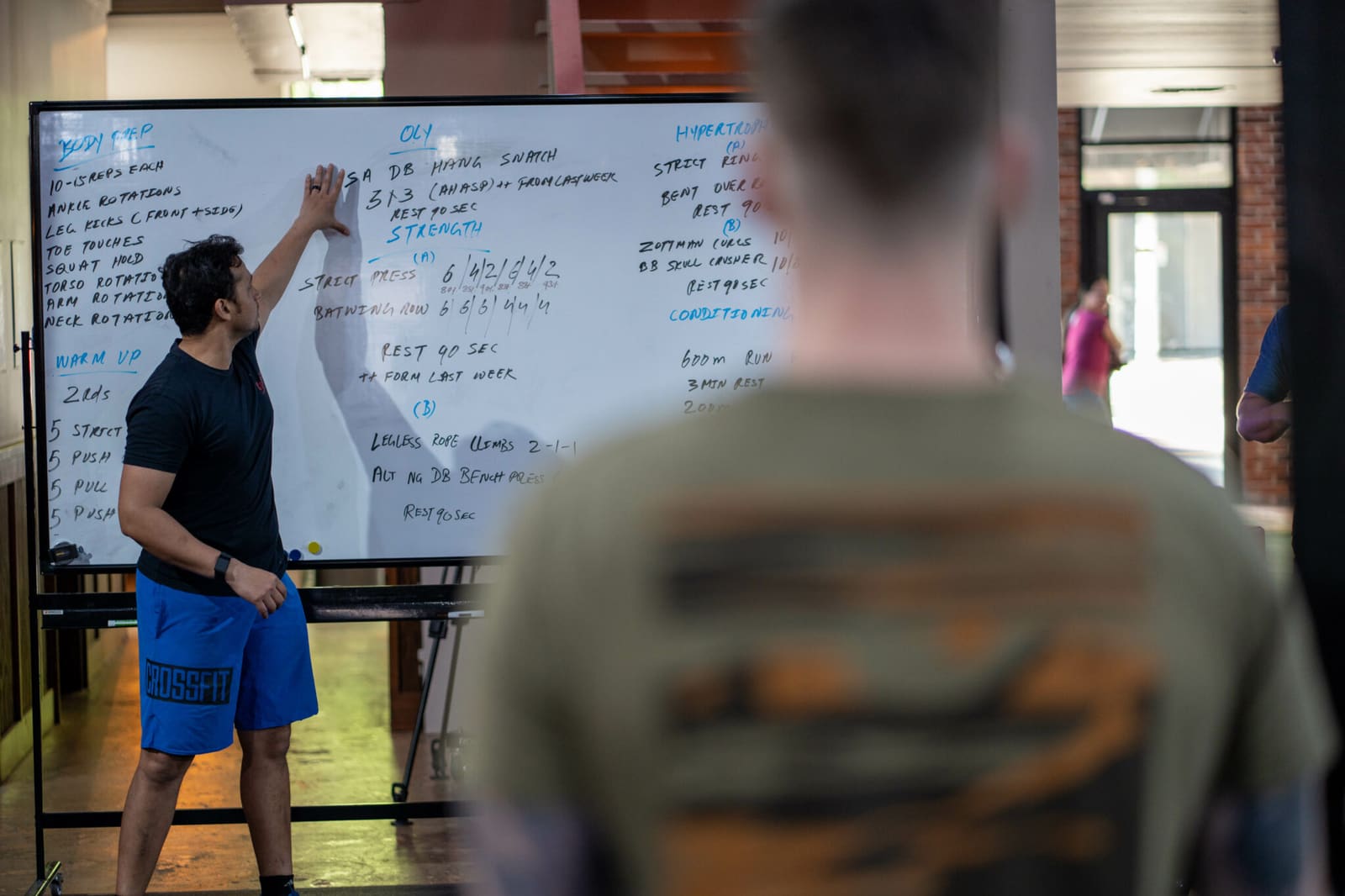
CrossFit programming is not random and never was
The single most common misconception about CrossFit, even among long-time members, is that the workouts are random. They are not. The variance is the program, not a substitute for it.
A coach who programs randomly produces a gym full of athletes who plateau in six months. A coach who programs deliberately, with periodization, energy system targeting, and progressive overload across a 12 week cycle, produces athletes who add load and capacity for years. The difference is invisible if you only look at one workout. It is unmistakable if you look at 12 weeks.
I am Ravi Dewangan, CFL3, MS in Strength and Conditioning, and CrossFit Seminar Staff. I have programmed for Persistence Athletics in Belltown for over a decade. This article is the technical breakdown of how CrossFit programming actually works, the periodization models that underpin it, and a real sample week from our current cycle. Updated June 2026.

Table of Contents
- The periodization models behind CrossFit programming
- Why 'random' is the wrong word
- The five energy systems and how programming targets them
- A real sample week from our current cycle
- How we program at Persistence Athletics
- Frequently Asked Questions
The periodization models behind CrossFit programming
Periodization is the structured organization of training over time. The three main models you will find in any S&C textbook are linear, block, and conjugate. CrossFit programming uses a hybrid of block and conjugate. Pure linear periodization does not fit CrossFit because the sport demands multi-modal fitness simultaneously.
Linear periodization
The classic powerlifting model. You progressively increase intensity and decrease volume across a 12 to 16 week cycle, peaking at week 12 to 14 with a meet. Weeks 1 to 4 are hypertrophy, 5 to 8 are strength, 9 to 12 are power. The model is excellent for a single peak event and poor for sports requiring sustained multi-modal performance. It does not fit CrossFit because the athlete has to be ready every day, not peaked once.
Block periodization
Developed by Russian sport scientists in the 1960s. The athlete trains one quality at a time in concentrated 2 to 4 week blocks, with each block building on the last. Block A is accumulation (high volume, lower intensity), block B is transmutation (moderate volume, higher intensity), block C is realization (low volume, peak intensity). The model fits CrossFit better than linear because each block can target a different quality (strength, power, conditioning) without sacrificing the others.
Conjugate periodization
Developed at Westside Barbell. Multiple qualities are trained concurrently within the same week. Monday is max effort upper body, Wednesday is max effort lower body, Friday is dynamic effort lower body, Saturday is dynamic effort upper body. The athlete is always strong, always fast, and always conditioned. The model fits CrossFit almost perfectly because it preserves multiple qualities simultaneously.
The CrossFit hybrid
Most well-programmed CrossFit gyms use a hybrid: conjugate within the week, block across cycles. A typical week trains heavy strength, dynamic effort, conditioning, and gymnastics within the seven days. Across an 8 to 12 week cycle, the strength block progresses linearly (volume down, intensity up), the conditioning block rotates energy system focus, and the gymnastics block adds skill complexity. The hybrid is what produces athletes who are strong, fast, and conditioned at the same time.
Why 'random' is the wrong word
The 'random' criticism comes from looking at a CrossFit workout in isolation. If Tuesday is back squat and Wednesday is rope climbs and Thursday is rowing intervals, the casual observer concludes the programming is random.
It is not random. It is varied within a structured cycle. The squat on Tuesday is part of a 12 week strength block at week 6 of 12, hitting 80 percent of one rep max for 3 sets of 5. The rope climbs on Wednesday are a gymnastics skill block, week 4 of 8, working from rope holds to single climbs to multiple climbs. The rowing on Thursday is a glycolytic energy system day, hitting 30 second intervals at 95 percent effort with 90 second rest, week 3 of 6.
What looks random in a daily snapshot is deliberate over a 12 week view. The programmer chose squat-rope climb-row not because those three movements are random, but because Tuesday is a heavy strength day (anterior posterior chain), Wednesday is a low intensity skill day (recovery from Tuesday plus skill development), and Thursday is a high intensity glycolytic day (different energy system, different muscle group, full recovery from Tuesday's squat).
I see the misread on the floor constantly. A member will tell me after a Wednesday skill day that they did not get a real workout, because no part of them was on the ground gasping. That low intensity skill day is what lets them squat hard again on Friday. The day that feels like nothing is doing structural work. Katie, who has built one of the most disciplined gymnastics progressions in the gym, strict pull-ups and clean ring work, did not get there on the days that felt brutal. She got there on the unglamorous skill blocks she did not skip.
The variance is the program. Single modality programs (powerlifting, marathon training) work for athletes who only need one quality. CrossFit athletes need multiple qualities. The varied program is the only model that delivers all of them.
The five energy systems and how programming targets them
Every workout taps one or more of the body's energy systems. Good programming hits all five over the course of a week. The five systems and their characteristics:
| Energy system | Duration | Intensity | Example movement |
|---|---|---|---|
| Phosphagen (ATP-CP) | 0 to 10 seconds | 95 to 100 percent | 1 rep max squat, max effort sprint |
| Glycolytic anaerobic | 10 seconds to 2 minutes | 80 to 95 percent | 400m sprint, Fran |
| Oxidative anaerobic | 2 to 5 minutes | 70 to 85 percent | 1 mile time trial, Helen |
| Oxidative aerobic | 5 to 60 minutes | 60 to 80 percent | 5K row, Murph |
| Long aerobic | 60+ minutes | 50 to 70 percent | Long ruck, multi-hour work |
The first three are anaerobic. The last two are aerobic. CrossFit athletes need all five. A week of programming hits roughly: 1 phosphagen day (heavy strength), 2 glycolytic days (short metcons), 1 oxidative anaerobic day (medium metcons), 1 oxidative aerobic day (long workout), and 1 mixed or skill day.
Programs that only train glycolytic and oxidative anaerobic produce athletes who are gassed in 90 seconds and have no aerobic base. Programs that only train aerobic produce athletes who can run forever but cannot lift heavy. The CrossFit model hits all five because the sport demands fitness across all five.
If you want to feel the long aerobic end of that table in a class, our Saturday HYROX session, 9:30 to 11:00 AM, is included in every membership (a $35 drop-in covers it too). It is the clearest example of programming the oxidative systems on purpose rather than by accident.
A real sample week from our current cycle
Here is a representative week from our current 12 week cycle at Persistence, week 7 of 12. The cycle is in the strength accumulation phase, working at 75 to 85 percent on the main lifts.
Monday: Heavy strength + short metcon
- Strength: Back squat. 5 sets of 3 at 82 percent of one rep max. 3 minute rest between sets.
- Metcon: 5 round AMRAP (every minute on the minute, EMOM)
- 5 deadlifts at 60 percent
- 10 hand release push-ups
- Energy systems hit: Phosphagen (squat), glycolytic (EMOM)
Tuesday: Skill + medium metcon
- Skill: Strict pull-up progression. 5 sets of 3 to 5 reps at appropriate scaling (band, partial, full).
- Metcon: 12 minute AMRAP
- 200m run
- 12 wall balls (20 lb prescribed, 14 lb scaled)
- 8 toes to bar (or hanging knee raises scaled)
- Energy systems hit: Oxidative anaerobic, mixed modal
Wednesday: Long aerobic
- Workout: 30 minute AMRAP at conversation pace
- 500m row
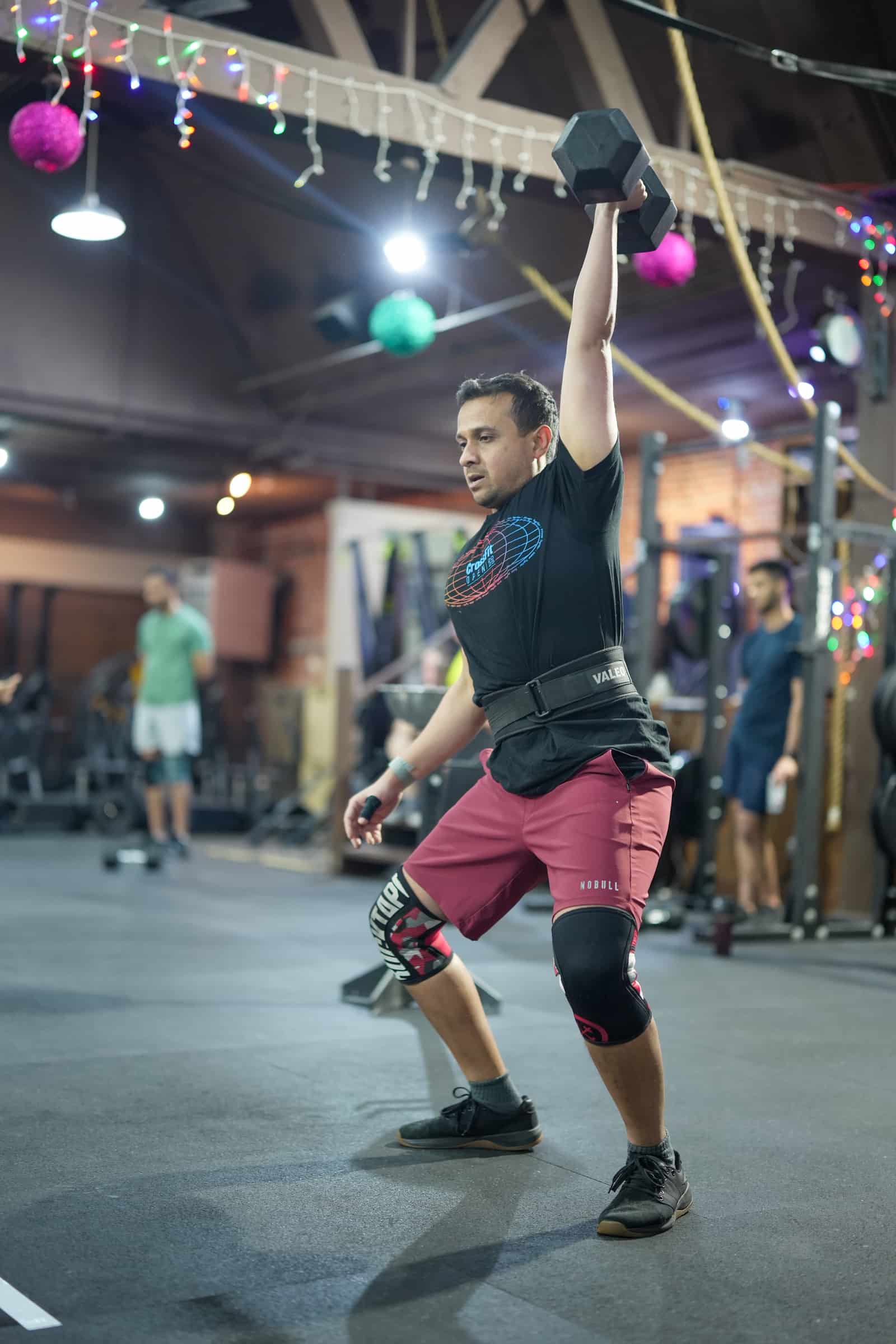
- 10 dumbbell snatches (50 lb prescribed)
- 200m run
- 15 air squats
- Energy systems hit: Oxidative aerobic, mixed modal at low intensity
Thursday: Mixed strength
- Strength A: Strict press. 4 sets of 5 at 75 percent of one rep max.
- Strength B: Front squat. 4 sets of 5 at 70 percent of one rep max.
- Metcon: 8 minute AMRAP
- 7 thrusters at 95 lb (65 lb scaled)
- 7 chest to bar pull-ups (banded scaled)
- Energy systems hit: Phosphagen (strength), glycolytic (metcon)
Friday: Heavy + intervals
- Strength: Deadlift. 5 sets of 3 at 80 percent of one rep max.
- Metcon: 5 rounds for time (cap 15 minutes)
- 400m run
- 12 box jumps at 24 inches (20 inches scaled)
- 8 power cleans at 115 lb (95 lb scaled)
- Energy systems hit: Phosphagen (deadlift), oxidative anaerobic (metcon)
Saturday: HYROX-style or partner WOD
- Workout: 4 round partner WOD, 30 minute cap
- 800m run together
- 50 wall balls (split as needed)
- 50 calorie row (split as needed)
- 50 lunges with kettlebell (split as needed)
- Energy systems hit: Oxidative aerobic, mixed modal
Sunday: Active recovery or rest
- Optional open gym for skill work or mobility. No structured class.
The week structure is deliberate. Two heavy days (Mon, Fri), one moderate day (Thu), one light skill day (Tue), one long aerobic day (Wed), one partner/mixed day (Sat), one rest day (Sun). Every energy system hit. Every movement pattern hit. No two consecutive heavy lower body days. The structure is what produces athletes who progress for years.
The fastest way to read a week like this is to stand inside one. Book a free class and drop into whatever day of the cycle we happen to be on; the logic of the structure shows up faster on the floor than on a page.
How we program at Persistence Athletics
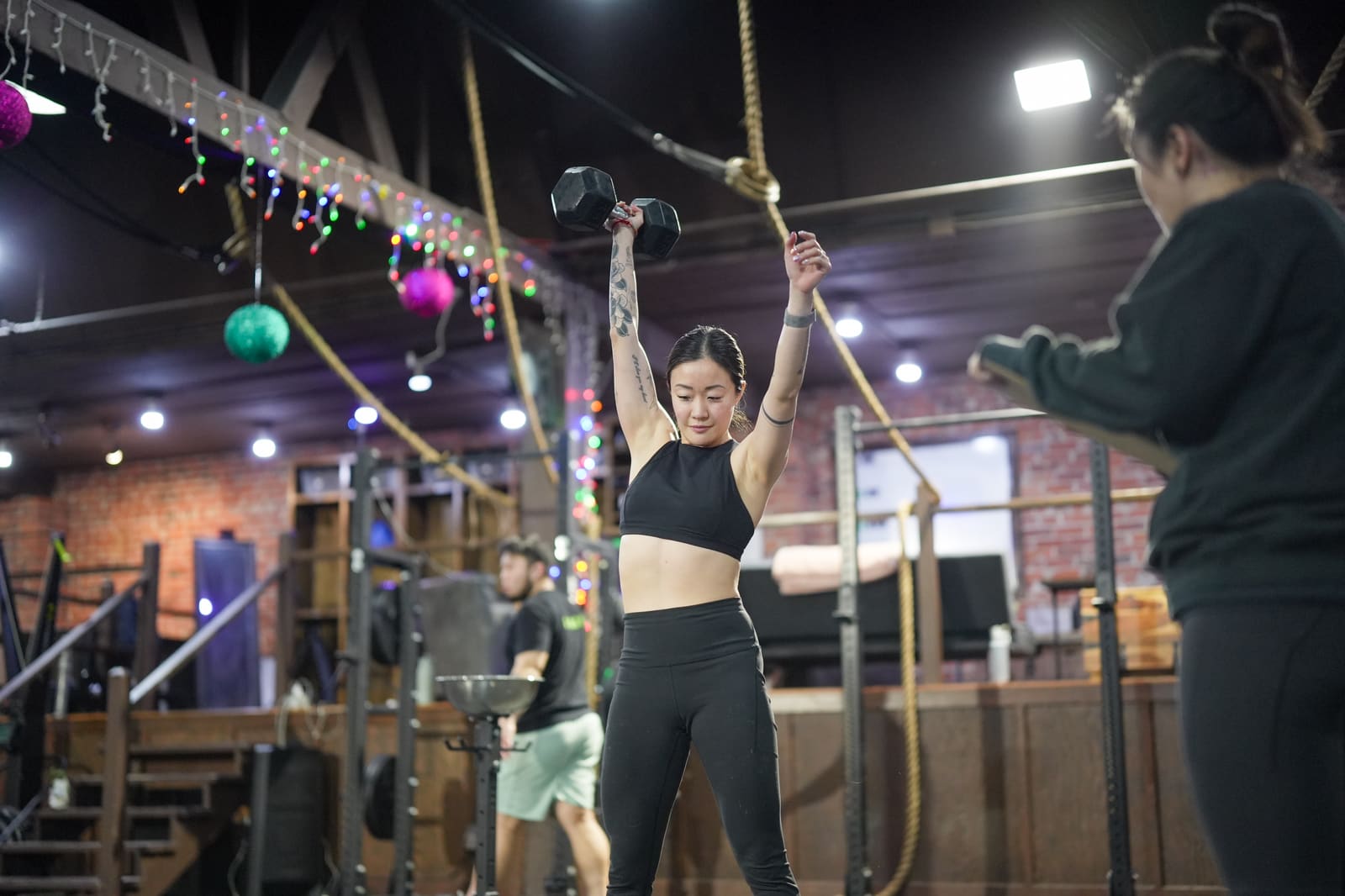
Programming at our Belltown CrossFit gym is a 12 week cycle that I author and the coaching team reviews. The cycle structure:
- Weeks 1 to 4: Accumulation. Higher volume, moderate intensity. Building the base that the next 8 weeks will progress on top of.
- Weeks 5 to 8: Transmutation. Volume comes down slightly, intensity comes up. Strength loads move from 75 percent to 85 percent.
- Weeks 9 to 11: Realization. Lower volume, higher intensity. Strength loads at 85 to 90+ percent. This is where most members hit PRs.
- Week 12: Deload. Active recovery, technique work, no max attempts.
Within each cycle, we cycle through movement variations every 4 weeks. Weeks 1 to 4 might emphasize back squat as the main squat variant. Weeks 5 to 8 might shift to front squat. Weeks 9 to 12 might use overhead squat. The variation prevents adaptation plateau and develops different positional strengths.
The CFL3 credential I hold required years of coaching plus a comprehensive practical exam covering programming, scaling, and movement assessment. The MS in Strength and Conditioning means the periodization theory underpinning our cycles is rooted in actual sport science literature, not Instagram trends. My wife and co-head coach, Jacque, also CFL3 and a Precision Nutrition Level 2 coach, owns the gymnastics progressions and the nutrition side, so the skill blocks in a cycle are programmed by someone who coaches those positions every day, not bolted on as an afterthought. For more on the coaching team and credentials, see our coaches page.
For members who want a deeper, more individualized program (specific PR goals, sport prep, return-from-injury), the strength training option at Persistence layers a custom strength block on top of group programming. This is the right call for athletes who have hit a plateau on group programming alone and need a more targeted stimulus.
Why following the program matters
The single biggest predictor of progress at any CrossFit gym is whether the member follows the programming as written. Members who cherry-pick (skip the days they do not enjoy, double up on the days they do) plateau in 4 to 6 months. Members who follow the program as written add load and capacity for 2 to 3 years before any meaningful plateau.
Devang is the cleanest example I can point to. He is a software engineer who walked in closer to the beginner end and is now one of the more advanced lifters in the room, 724 classes deep. He did not get there by hunting for the fun days. He showed up for the accumulation weeks that feel like grinding, the skill days that do not leave a mark, and the deloads where his ego wanted to keep loading the bar. The arc from beginner to advanced is built almost entirely out of the boring weeks.
The math is straightforward. The program is built on progressive overload across a 12 week cycle. Skipping the volume in week 4 invalidates the intensity in week 8. Doubling up on heavy squats in week 6 produces overtraining by week 9. The program is not a menu. It is a structure.
The members at Persistence who hit lifetime PRs in their first year follow the program. The members who do not hit those PRs are usually doing their own variation of the program. The variable is not effort. The variable is adherence to a programmed cycle.

Frequently Asked Questions
Is CrossFit programming actually random?
No. The 'random' label comes from looking at one workout in isolation. Across a 12-week training cycle, well-programmed CrossFit gyms hit every energy system, every movement pattern, and every load range in deliberate proportions. Variance within a week creates the appearance of randomness; the cycle structure across weeks reveals the actual programming logic.
What periodization model does CrossFit use?
Most well-programmed CrossFit gyms use a hybrid of conjugate periodization (varying intensity and movement daily) and block periodization (8 to 12 week strength cycles). Pure linear periodization does not work for CrossFit because the sport demands fitness across multiple energy systems simultaneously. The hybrid model preserves strength gains while training conditioning.
How long should a CrossFit strength cycle be?
8 to 12 weeks per cycle, with a 1 week deload at the end. Cycles shorter than 6 weeks do not produce real strength adaptation. Cycles longer than 12 weeks produce diminishing returns because the lifter adapts to the stimulus. We program 12 week cycles at Persistence with movement variation every 4 weeks within the cycle.
Why does CrossFit programming include so many movement variations?
Because CrossFit trains general physical preparedness, not a single sport. The variation is not arbitrary; it is dose-managed across a cycle. Within a week you might see back squat, front squat, and overhead squat. Each is a different stimulus on overlapping musculature. The variation prevents the adaptation plateau that single-modality training hits at 6 to 12 weeks.
What is the ideal weekly CrossFit class structure?
5 to 6 days of varied programming with at least 1 full rest day. A typical week hits 2 heavy strength days, 1 long aerobic day, 1 to 2 mixed-modal metcon days, and 1 skill or gymnastics-focused day. Hitting all five energy systems in a week is the structural goal. Sample weekly templates exist at most coached gyms and are usually shared with members.
Should I follow my CrossFit gym's programming or do my own?
Follow the gym's. The reason most members under-progress is that they cherry-pick which workouts to do based on what they feel like. The programming is built around progressive overload across an 8 to 12 week cycle, and skipping the squat day in week 6 invalidates the whole cycle. If you want a custom program, that is what personal training is for.
Try a free first class at Persistence Athletics
If you want to see what programmed (not random) CrossFit looks like, your first class at Persistence Athletics in Belltown is free and scaled to wherever you are starting. Walk into a class in the middle of our current cycle and the structure of the programming should be obvious by minute 30. Book your free class. Persistence Athletics, 3025 1st Ave, Belltown, Seattle, WA 98121. Call (206) 593-4236. About 8 minutes on foot from the Amazon Spheres, walkable from anywhere in Belltown, SLU, and downtown.
Want to take this further?
Talk to a coach about crossfit programming at Persistence Athletics.