
From CrossFit to HYROX: A Belltown Athlete's Story
How Aman, a CrossFit Open athlete in Belltown, trained 12 weeks for his first HYROX race. Programming, mental shifts, and what changed. From a CFL3 head coach.


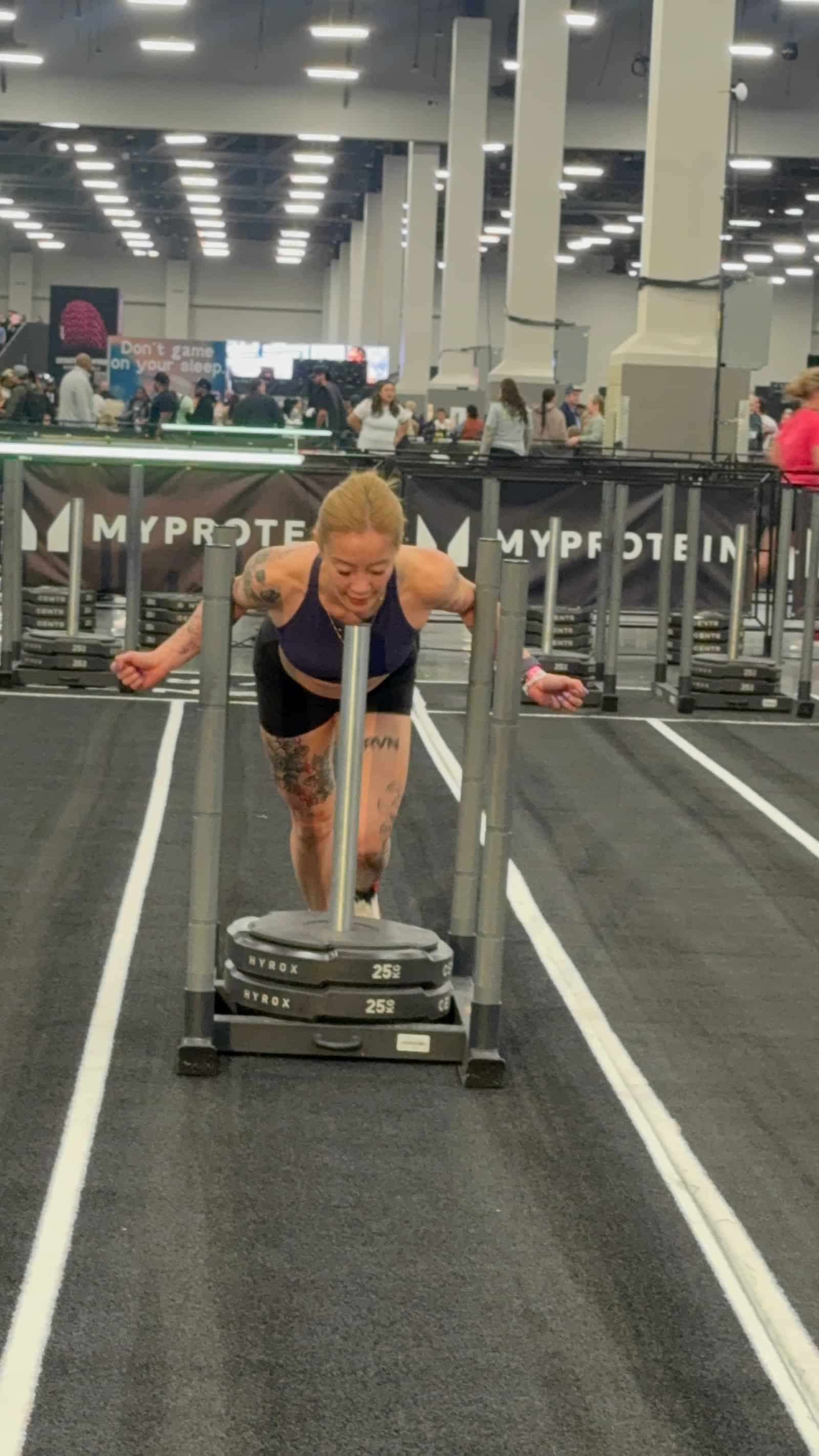
Aman walked into Persistence as a CrossFit Open athlete. 12 weeks later he finished his first HYROX.
The first time I watched Aman move through a HYROX-style metcon, he was carrying the room. Deep, controlled squats. Fast burpees that did not slow down. Wall balls that hit the same spot on the target every rep. He had been doing CrossFit at Persistence Athletics in Belltown for a couple of years, he had two CrossFit Opens behind him, and he was an engineer who sat at a desk all day before he found us. The strength, the gym fitness, the work capacity were all there. He was ready for the stations on day one.
Then we sent him out the door for a 5 km run at conversational pace as part of his assessment. He came back winded and a little annoyed. The strength was there. The engine was not. The first kilometer felt fine. By kilometer 3 he had slowed noticeably. By kilometer 5 he was walking and watching his watch.
That gap, between the strength of a CrossFit athlete and the run base of a HYROX racer, is the gap most CrossFitters have to close to race well. Aman closed it in 12 weeks and finished his first HYROX Singles as a solid top-third first-timer.
This is his story. The intake, the programming shifts, and what changed week by week. I'm Jacque Dewangan, CFL3 and Precision Nutrition Level 2, head coach at Persistence Athletics. Updated June 2026.
(Note: Aman is a representative archetype based on real Persistence members, including more than one sedentary-engineer-to-racer arc we have coached on the floor in Belltown. The training programming and timeline are exactly as we run them.)
Table of Contents
- The starting point: CrossFit-strong, run-light
- Phase 1 (weeks 1-4): aerobic base building
- Phase 2 (weeks 5-8): HYROX-specific work
- Phase 3 (weeks 9-12): race-pace simulations and taper
- Race day and what changed
- How we run CrossFit-to-HYROX programs at Persistence
- Frequently Asked Questions
The starting point: CrossFit-strong, run-light
Aman's intake screen at the start of his 12-week block told a clear story: strong in the gym, untested on the road.
Strength. Squat, hinge, and press were all well above bodyweight, the kind of numbers a few years of consistent CrossFit will build. Ravi, our head S&C coach (CFL3, MS in Strength and Conditioning), looked at his lift history and signed off on maintaining strength through the block rather than chasing it. There was nothing to fix there.
Stations (fresh state). SkiErg, sled push, wall balls, burpee broad jumps. All comfortable. All in CrossFit rep ranges he had been living in for years. None of the HYROX stations scared him on paper, and none of them should have.
Running. This is where the gap lived. His best single kilometer felt fast, but he could only produce it once. His 5 km pace fell apart well before the finish, and he had not run a sustained effort over 30 minutes in two years. Above 5 km had simply never been tested.
Heart rate response. His HR climbed quickly during the runs and recovered slowly. That is the classic profile of a strong-engine athlete who has never built a deep aerobic base. The fitness is real. It just does not have a low gear.
The plan was simple in shape. Build the run base in phase 1. Layer HYROX-specific work in phase 2. Race-pace simulate in phase 3. Strength would maintain rather than progress, because stacking strength volume on top of new run volume tanks recovery for an athlete already at a high training age.

Phase 1 (weeks 1-4): aerobic base building
The first 4 weeks were almost entirely about running. Aman cut his CrossFit volume from 5 days a week to 3 and added 3 dedicated run sessions. Some of those easy runs he did along the waterfront down the hill from the gym, which beats a treadmill for the long ones.
Weekly structure
- Monday: CrossFit class (regular programming)
- Tuesday: Easy run, 30 to 40 minutes at conversational pace (zone 2)
- Wednesday: CrossFit class
- Thursday: Run intervals, short. 6 to 8 x 400 m at moderate effort with 90 second rest
- Friday: Rest or mobility
- Saturday: HYROX class at Persistence (race-pace exposure)
- Sunday: Long easy run, building from 5 km to 8 km across the 4 weeks
What changed
By the end of week 4, Aman could hold his target 5 km pace without his HR spiking and crashing. His aerobic base had built enough that he could repeat hard efforts without his recovery falling apart the next day. The CrossFit work actually felt easier, because his cardio system finally had headroom under it.
His main complaint at the end of phase 1: he missed the heavy CrossFit days. That trade-off is real. To get HYROX-ready you have to give some gym volume back for a while. Aman accepted it because he understood the timeline and trusted where it was going.
If you have ever wondered whether your gym fitness would carry over to a race, the honest answer is that most of it does. The running is the part you build. Booking a free first class is the easiest way to find out where your own gap sits before you commit to a block.
Phase 2 (weeks 5-8): HYROX-specific work
Phase 2 layered the HYROX-specific stations on top of the run base. The runs got slightly faster, the stations became HYROX-flavored, and the pacing started to take shape.
Weekly structure
- Monday: CrossFit class
- Tuesday: Threshold run intervals (4 x 1 km at goal HYROX pace + 30 seconds, with 2 minute rest)
- Wednesday: HYROX-specific metcon (3 to 4 stations at race pace, with 1 km runs between)
- Thursday: Strength maintenance (squat, hinge, press, pull) plus easy aerobic 20 minutes
- Friday: Rest
- Saturday: HYROX class at Persistence (longer race-pace exposure, 4 to 6 stations)
- Sunday: Long run, 8 to 10 km at conversational pace
What changed
By week 6 Aman could hold a 5 km that would have wrecked him in week 1. His station times stayed strong, because the CrossFit base never went anywhere. The new skill was chaining stations and runs together. The first time he ran a kilometer straight into a sled push and back out into another kilometer, his second run was 30 seconds slower than the first. By week 8 that gap was down to about 10 seconds. That shrinking number is the whole point of the phase.
The HYROX class at Persistence is where this work happened in coached form. Members preparing for races attend the Saturday HYROX class, 9:30 to 11:00 AM, consistently across phases 2 and 3. It is included in every membership, so there is no separate HYROX fee to deal with mid-block. Aman was there every Saturday.
Phase 3 (weeks 9-12): race-pace simulations and taper
Phase 3 was three race-pace simulations and a taper. Less about adding fitness, more about rehearsing the race itself.
Week 9
Partial sim: 4 stations plus 4 km of running at race pace. Aman ran it clean, and the projection it produced was promising enough that we nudged his pacing target down a touch. The first sim is mostly about proving the engine is real under fatigue. His was.
Week 10
Full sim: all 8 stations plus 8 km of running at race pace. This one went sideways in a useful way. He came out of the gate too fast on the first kilometer, felt great for 20 minutes, then crashed at station 4 and limped through the back half. The full-sim time came in slower than the partial had projected. That is exactly the lesson you want a CrossFitter to learn in week 10 and not on race day. We spent the next two weeks drilling the pacing protocol.
Week 11
Partial sim with corrected pacing: 5 stations plus 5 km, with a deliberately easy first kilometer. The result was even splits, no station crash, and a projection that put him back ahead of his week-9 number. Same athlete, smarter pacing.
Week 12
Taper. Volume cut by 50 percent. Two short workouts, one easy run, one mobility session, race on Saturday. The taper is non-negotiable. CrossFit athletes almost always want to keep training hard right up to race day, and they almost always underperform when they do. Aman wanted to. He did not. That discipline showed up in his result.
Race day and what changed
Aman finished his first HYROX Singles as a top-third first-timer. His station splits sat close to his fresh-state benchmarks, which is the sign that he paced correctly and arrived at each station with the right amount of fatigue in the tank instead of a deficit.
Two things he said after the race that stuck with me.
First: "I had so much left for the wall balls. I was scared of the wall balls for 12 weeks and they were the easiest part of the day."
Second: "The first kilometer was the hardest part. Holding back when my legs felt fresh was the discipline I did not have at the start of prep."
Both are textbook for CrossFitters racing HYROX. The strength-based stations feel manageable because they are CrossFit movements you already own. The pacing discipline is the thing you have to go out and earn.
After the race, Aman went back to his regular CrossFit programming. He did the next CrossFit Open in February and felt noticeably better on the longer metcons, because his aerobic base had jumped a full level. The HYROX cycle made him a better all-around athlete, not just a HYROX racer. That is the pattern we see across most of our CrossFit-to-HYROX members, and it is why we keep recommending one race cycle a year even to people who never thought of themselves as runners.
How we run CrossFit-to-HYROX programs at Persistence
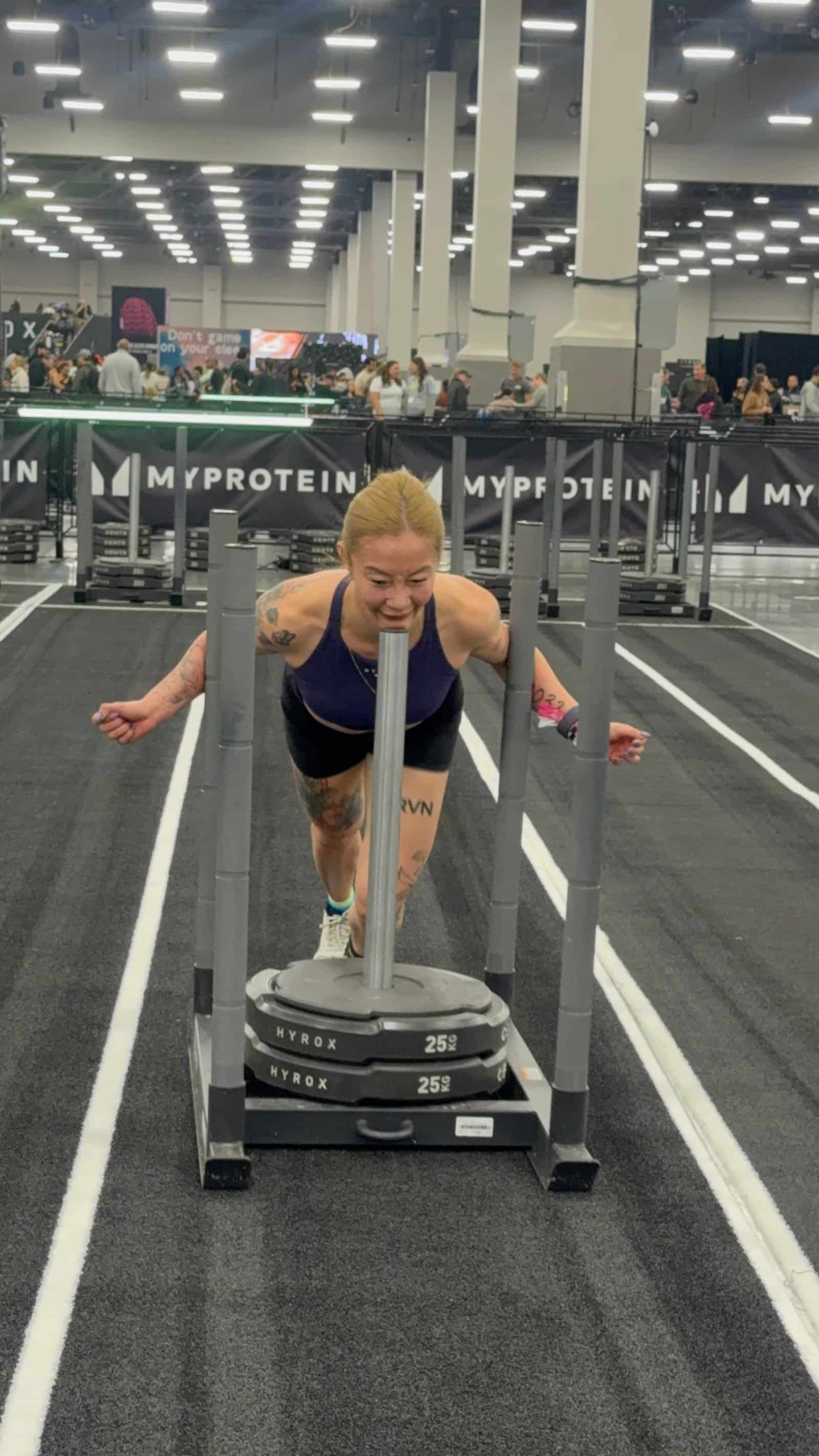
Persistence Athletics in Belltown runs a HYROX program that integrates with our regular CrossFit programming. Members can do HYROX-specific prep cycles 2 to 3 times per year (typically spring and fall) while keeping their CrossFit routine in between.
The program structure is the same one we used with Aman: 12 weeks of progressive prep with a clear taper. Members who want one-on-one programming during their cycle work with one of our coaches; the Saturday HYROX class, 9:30 to 11:00 AM, is open to every member and included in the membership. AJ and the rest of the crew run the weekday classes that keep your strength humming while the run volume ramps.
For other member transformation stories, our member transformations hub collects 5 case studies, including Aman's, Eric's chronic back pain to strict pull-ups story, and Tom, who at 66 still trains hard alongside racers half his age. Each links to a longer post if you want the full story.
For the philosophy behind how we coach, see our about page. For our regular CrossFit programming and how it integrates with HYROX prep, see group classes.
The pattern Aman followed is repeatable. CrossFitters who give themselves 12 to 16 weeks of focused HYROX prep, who add the run volume, who practice the race pace, and who taper properly almost all finish well in their first HYROX. The strength is already there. The work is closing the running and pacing gap.
Frequently Asked Questions
Can a CrossFit athlete transition to HYROX easily?
Yes, with some adjustments. CrossFit athletes already have the strength, the mixed modal capacity, and the gym fitness needed for the stations. The two main gaps are sustained running volume (CrossFit rarely programs 8 km of running in a single session) and pacing for a 60 to 120 minute event. With 12 weeks of focused prep, most CrossFit athletes can perform well at their first HYROX.
What does a CrossFitter need to add for HYROX prep?
Three things. First, longer aerobic runs (3 to 8 km at conversational pace, 1 to 2 times per week). Second, race-pace simulations of HYROX-specific stations. Third, pacing practice for a longer-duration event. Most CrossFitters come into HYROX prep with the strength they need but with run volume that is too low for an 8 km race.
Will HYROX training hurt my CrossFit Open performance?
Not if it is timed right. HYROX prep done in the off-season (after the Open and before the next CrossFit season) actually improves Open performance because of the increased aerobic capacity. HYROX prep done during Open prep can compete for adaptive resources. Most of our members do HYROX in spring or fall and the Open in February.
How long does it take to go from CrossFit to HYROX-ready?
12 weeks is the standard prep timeline for athletes who are already fit. CrossFit athletes typically need a slightly longer aerobic ramp than this baseline (an extra 2 to 4 weeks of running base building) but can compress the strength and station training because the foundation is already there. Total prep window: 12 to 16 weeks.
Are HYROX stations harder for CrossFitters than for runners?
Stations are easier for CrossFitters than for runners. The sled push, sled pull, wall balls, and burpee broad jumps all have CrossFit equivalents. Runners often struggle with the strength components. The gap goes the other way for the runs: runners come into HYROX with a strong run base, CrossFitters often need to build it. Hybrid athletes have the best of both.
Should I do HYROX or CrossFit if I can only pick one?
Pick CrossFit if you want broad fitness, community, year-round programming, and skill diversity (gymnastics, Olympic lifting, varied modalities). Pick HYROX if you specifically want race events and a more focused training cycle. Most of our members do both: CrossFit as the year-round base, HYROX as the targeted race cycle 2 to 3 times per year.
Try a free first class at Persistence Athletics
If you are a CrossFitter thinking about HYROX, your first class at Persistence Athletics in Belltown is free and scaled to wherever you are right now. Come to the Saturday HYROX class at 9:30 AM and run a station rotation with us. You will learn within 60 minutes whether HYROX is your next race.
Book your free class. Persistence Athletics, 3025 1st Ave, Belltown, Seattle, WA 98121. About 8 minutes on foot from Amazon and walkable from anywhere in downtown Seattle. Questions first? Call us at (206) 593-4236.
Want to take this further?
Talk to a coach about hyrox programming at Persistence Athletics.