
Pacing Strategy for Your First HYROX Race
How to pace your first HYROX race without blowing up. Target splits for sub-90, sub-100, and sub-120 finishers, from a CFL3 coach in Belltown Seattle.

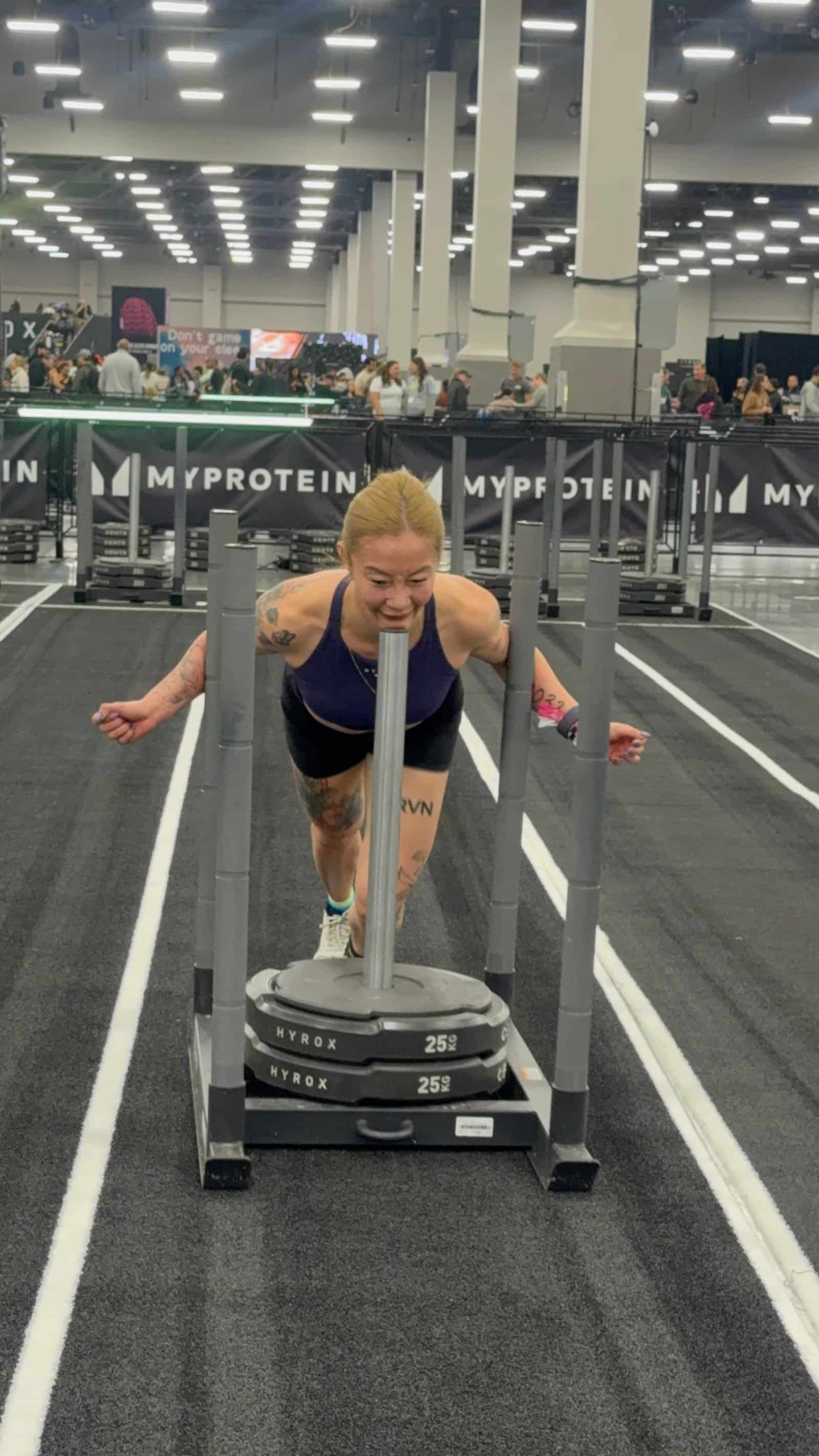
The first 1 km of your first HYROX race is not the time to test your speed.
Almost every first-time HYROX racer I have coached at Persistence Athletics walks into the corral with the same plan: "go out steady, see how I feel." Then the gun goes off, the adrenaline kicks in, and they run the first 1 km in 4:45 instead of 6:00. The sled push at station 2 takes 30 percent longer than it should. By station 4, the legs are gone, and the rest of the race is damage control.
The race is not won in the first 1 km. It is lost there. HYROX is a 60-to-120-minute event, and the pacing curve that produces the best result is the opposite of what feels right at the start. You are supposed to feel like you are leaving time on the table for the first 20 to 30 minutes. If you feel like you are racing in the first 1 km, you are racing the wrong race.
I'm Ravi Dewangan, CFL3, MS in Strength and Conditioning, and CrossFit Seminar Staff. I have coached first-time racers through their HYROX prep at Persistence Athletics in Belltown for several years. One of them, Aman, came in as a sedentary software engineer who could barely string runs together, and a couple hundred classes later qualified for a HYROX. The thing that moved him from "survive it" to "race it" was not a fitness jump. It was pacing. This is the framework I walk every athlete through before their first race. Updated June 2026.
Table of Contents
- The 3 rules of HYROX pacing for first-timers
- Target pace chart by finisher time
- Why the sled stations are recovery (if you pace them right)
- How we coach pacing at Persistence Athletics
- The 5-step in-race pacing protocol
- Frequently Asked Questions
The 3 rules of HYROX pacing for first-timers
The pacing logic for HYROX comes down to three rules. Memorize them.
Rule 1: Do not blow up in the first 1 km. The first run is the easiest part of the race because you are fresh. It is also the most dangerous because feeling fresh tempts you to run faster than your sustainable pace. Run the first 1 km at roughly 80 percent of your fresh-state 1 km pace. For most first-timers, that means 5:30 to 6:30 per km, even if you can do 4:30 fresh.
Rule 2: The sled stations are recovery if you pace them. The sled push and sled pull look brutal on paper, but the run-in transitions and the relatively short distance (50 m each) mean these stations can actually function as breath-restorers if you do not arrive at them already gassed. Athletes who blow up the first 1 km waste this opportunity.
Rule 3: Save 10 percent for the last 4 stations. Stations 5 (Row), 6 (Farmers Carry), 7 (Sandbag Lunges), and 8 (Wall Balls) are where most races are won or lost. Athletes who race the first half "by feel" usually have nothing left for these. The wall balls at station 8 punish anyone who burned matches early. Hold back through stations 1 to 4 so you can press through 5 to 8.
These three rules apply regardless of finisher time goal. Whether you are aiming for sub-75 or sub-120, the curve is the same: hold back early, race the back half.
Target pace chart by finisher time
Use this chart as a starting point for first-race pacing. Adjust based on your week 8 race-pace simulation.
| Goal time | Per-km run pace | SkiErg | Sled Push | Sled Pull | Burpee Broad Jumps | Row 1000 m | Farmers Carry | Sandbag Lunges | Wall Balls |
|---|---|---|---|---|---|---|---|---|---|
| Sub-75 (elite) | 4:00 to 4:15 | 4:00 | 1:45 | 2:00 | 3:30 | 3:30 | 1:15 | 3:30 | 4:00 |
| Sub-90 | 4:30 to 4:45 | 4:30 | 2:15 | 2:30 | 4:00 | 4:00 | 1:30 | 4:00 | 5:00 |
| Sub-100 | 5:00 to 5:15 | 5:00 | 2:45 | 3:00 | 4:30 | 4:30 | 1:45 | 4:30 | 6:00 |
| Sub-120 | 6:00 to 6:30 | 6:00 | 3:30 | 3:45 | 6:00 | 5:30 | 2:15 | 6:00 | 8:00 |
A few notes. The sub-75 row is for elite-level athletes who have raced HYROX before and have a deep aerobic base. Most first-timers should look at sub-100 or sub-120. Sub-90 is achievable for first-timers with strong CrossFit or running backgrounds. Above 120 minutes is typical for first-timers with limited prep, and there is no shame in it.
The run paces assume you can hold them across all 8 km, not just the first 1 km. Most first-timers can hold their first-1-km pace fresh, but the cumulative fatigue from station work slows them by 15 to 30 seconds per km on the back half. Plan for that.
Why the sled stations are recovery (if you pace them right)
The sled push and pull look like the hardest stations on paper. They are short (50 m each), heavy, and physically demanding. But they are also the most pace-friendly stations in the race for one reason: they require near-maximal effort for a short duration, then end. Compare that to the burpee broad jumps (80 m, sustained mid-effort) or wall balls (100 reps, sustained mid-to-high effort), which grind for several minutes.
Here is what makes the sleds "recovery":
- Short duration. 30 to 90 seconds of all-out effort, then over.
- Different muscle pattern. Sled push uses isometric core, leg drive, and arms in extension. Different from running mechanics. The cardio system has a moment to redistribute.
- Walk-back transitions. The judge resets the sled while you walk back to the start of the lane, which can take 10 to 20 seconds of light recovery.
- Set rep targets. Unlike a long station, you know exactly when it ends. Mental recovery comes with the visual cue of the finish line of the lane.
This only works if you arrive at the sled in good shape. Athletes who run the first 1 km too fast are already cooked at the sled and do not benefit from this dynamic. Pace the first 1 km correctly, and the sleds become effective recovery stations.
If your race is close and you want a coach to walk your pacing with you in person, the HYROX class at Persistence Athletics runs Saturdays 9:30 to 11:00 AM and is included in every membership. You can also drop in for $35, which covers the same Saturday session. No separate HYROX pricing. New here? Book a free class and we will rehearse your race pace together.
How we coach pacing at Persistence Athletics

The HYROX class in Belltown is built around race-pace simulations, not just hard cardio. Members training for a specific race spend 4 to 6 weeks doing partial sims at race pace, then a full sim 2 to 3 weeks out. The goal of the sims is not just fitness. It is pacing rehearsal.
The most common pacing mistake I see in first-timers is running the first 1 km at fresh-state pace because the body feels good. We address it with a structured drill: run 1 km at goal pace plus 30 seconds, then immediately hit a sled push and a SkiErg. The point is to feel how much slower the stations get when the run was too fast. Aman is the cleanest example I have. In his first sim he went out hot on the run, hit the sled, and his SkiErg split fell off a cliff. He did not believe the slow-first-kilometer rule until he watched his own numbers crater in front of him. By his third sim he was running the first kilometer 40 seconds slower than he wanted to and posting better station times because of it. That is the whole lesson in one athlete.
For members who want one-on-one race coaching, working with me directly on a 12-week HYROX block produces the most consistent first-race results. We dial pacing across 4 simulations and have a clear race plan by week 11. For the broader Seattle HYROX scene including races and other gyms, see our HYROX Seattle training guide.
The mental side of pacing matters as much as the physical. First-time racers usually under-trust their training. The fix is rehearsal: do enough race-pace simulations that race day feels like the eighth time you have done this, not the first.
The 5-step in-race pacing protocol
This is the protocol I write down for every first-time racer the night before their race.
Pre-race: write your splits on your hand. First-1-km pace, station 1 SkiErg target time, station 2 sled push target time. You will forget mid-race. Having them on your hand removes guesswork.
First 1 km: run by heart rate and feel, not pace. Goal: zone 3, conversational. If you can answer a question in a full sentence at the 500 m mark, you are pacing right. If you cannot, slow down.
Stations 1 to 3: hit your target station times within 10 seconds. Faster is not better. Faster station times before station 4 mean you are burning matches. Match your targets, not beat them.
Mid-race check at station 4 (burpee broad jumps): how do you feel? If you feel destroyed, you went out too hard. Slow down for the next 1 km run, hit the row easy, and try to limit damage. If you feel fine, hold the pacing through stations 5 to 7.
Stations 6 to 8: this is where you race. From the farmers carry on, push past your targets if you have it. The wall balls are the final test. Save just enough that you can do the wall balls in 2 to 3 sets without long breaks. Sprint the last 1 km if you have it.
The athletes who follow this protocol regularly come in within 5 minutes of their target time on their first race. The athletes who freelance the pacing usually come in 10 to 20 minutes off, in either direction. The race rewards a plan.

Frequently Asked Questions
What pace should I run my first HYROX race?
Run the first 1 km at roughly 80 percent of your fresh-state 1 km pace. For most first-time racers that is 5:30 to 6:30 per km. The most common first-race mistake is running 1 km in 4:45 because you feel fresh, then crashing on the sled push and never recovering. Slow first kilometer, even efforts after that.
Are the sled stations recovery time?
Sort of. The sled push and pull are full-effort stations, but the run-into-sled transition gives you 5 to 10 seconds of slower walking pace before you grip and drive. Use that transition to get your breathing under control. Once you start the sled, push hard. The recovery is in the transitions, not the stations themselves.
Should I save energy for the wall balls?
Yes. The wall balls are station 8, after roughly 90 minutes of work. Most first-timers under-estimate how much grip and leg fatigue they will have arrived at. Aim to leave 10 percent in the tank through stations 5 to 7 so you can hold continuous form on the wall balls without long breaks. Saving 30 seconds on station 6 to lose 3 minutes on station 8 is a bad trade.
How do I know if I am pacing right during the race?
Three checks. First, can you still talk in short sentences after the run portions? If yes, your run pace is correct. Second, are your station times within 10 percent of your fresh-state benchmarks? If yes, you are not blown up. Third, do you feel a little better at station 6 than station 4? If yes, your pacing is sustainable. If station 4 already feels worse than station 8 should, you went out too hard.
What is a good first HYROX race time?
For first-time racers with 12 weeks of focused prep, aim for 90 to 110 minutes (men) or 100 to 120 minutes (women). Sub-90 men and sub-100 women are well-conditioned first-timers. Sub-75 men and sub-85 women are typically experienced HYROX racers or elite-level athletes. Set the time goal after your first race-pace simulation in week 8 of prep.
How do I avoid blowing up in the first 30 minutes?
Run the first 1 km at conversational pace. Hit station 1 (SkiErg) at moderate effort, not full effort. The race is 60 to 120 minutes. The first 30 minutes determine whether you race the back half or survive it. Almost every first-time racer who DNFs or crashes did so because they ran the first 1 km too fast. Hold back.
Try a free first class at Persistence Athletics
If you are racing your first HYROX and want a coach who will rehearse pacing with you, your first class at Persistence Athletics in Belltown is free and scaled to where you are. We will walk through your race plan and slot you into a Saturday pacing simulation if your race is within 8 weeks.
Book your free class. Persistence Athletics, 3025 1st Ave, Belltown, Seattle, WA 98121. About 8 minutes from Amazon, walkable from anywhere in downtown Seattle. Questions first? Call us at (206) 593-4236.
Want to take this further?
Talk to a coach about hyrox programming at Persistence Athletics.