
HYROX Stations: All 8 in Order, Weights + Coach Cues
All 8 HYROX stations in order with men's and women's weights, the top mistake at each, and the coach cue that fixes it. Plus time targets per station.

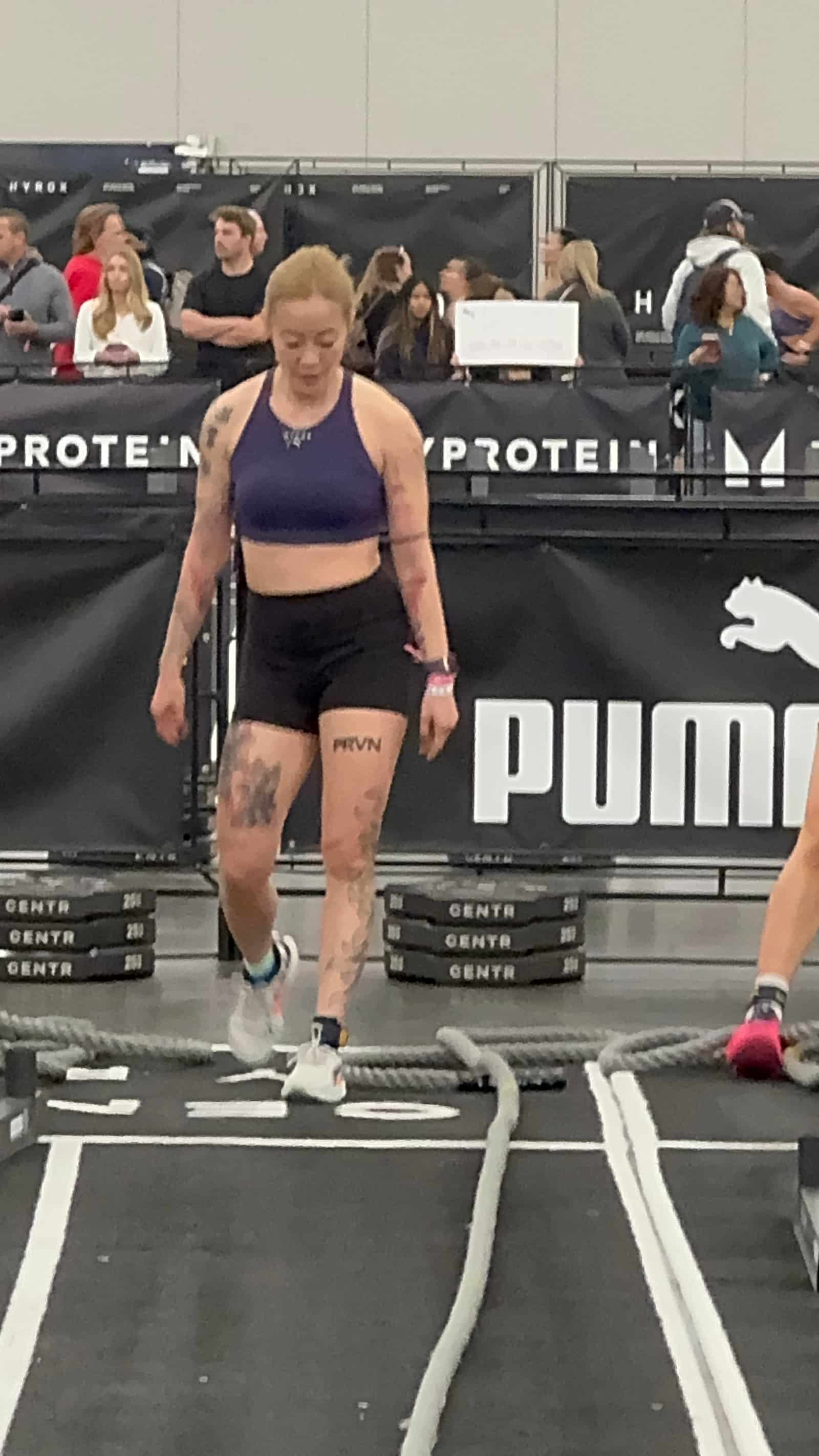
The HYROX format never changes. Train for what is on the test.
The reason HYROX has grown faster than any fitness race in the last 5 years is the same reason it confuses first-time racers: the format is fixed. Every HYROX race in the world has the same 8 stations in the same order separated by 1 km runs. There is no surprise WOD, no judge's discretion on movement standards, no mystery distance. You know exactly what is coming.
The 8 HYROX stations in order:
- SkiErg - 1,000 m
- Sled Push - 50 m (152 kg men / 102 kg women)
- Sled Pull - 50 m (103 kg / 78 kg)
- Burpee Broad Jumps - 80 m (bodyweight)
- Rowing - 1,000 m
- Farmers Carry - 200 m (2x24 kg / 2x16 kg)
- Sandbag Lunges - 100 m (20 kg / 10 kg)
- Wall Balls - 100 reps men / 75 reps women (6 kg / 4 kg ball)
A 1 km run comes before every station: 8 runs plus 8 stations, all in fixed order at every race in the world.
That clarity is also the trap. Because the test is fixed, every gap in your training shows up in the same place every time. If your wall ball form breaks down under fatigue, you will lose 2 to 4 minutes at station 8 of every race you run. If your sled push technique is bad, you will burn matches on station 2 that you needed for the back half. The race rewards specific preparation.
I'm Ravi Dewangan, CFL3, MS in Strength and Conditioning, and CrossFit Seminar Staff. I have programmed HYROX prep for dozens of athletes at Persistence Athletics in Belltown, and watched a lot of first races. One of them was Aman, who walked in a desk-bound software engineer with basically no training history and built up over a couple hundred classes into a HYROX qualifier. He did not get there because he was gifted at sleds. He got there because we trained the test, station by station, and fixed the same three technique leaks every first-timer has. This article walks through all 8 stations: what each one is, the most common technique mistake, and a training drill that fixes it. Updated June 2026.
Table of Contents
- The 8 stations in order
- Stations 1 to 4: SkiErg, Sled Push, Sled Pull, Burpee Broad Jumps
- Stations 5 to 8: Rowing, Farmers Carry, Sandbag Lunges, Wall Balls
- How we coach the stations at Persistence Athletics
- Station-specific training drills you can run weekly
- Frequently Asked Questions
The 8 stations in order
Every HYROX race runs the same 8 stations in the same order. A 1 km run separates each station. The stations are completed inside the "Roxzone" (a marked area for stations), and runs happen on a marked course outside it.
| # | Station | Distance / reps | Men's load | Women's load |
|---|---|---|---|---|
| 1 | SkiErg | 1000 m | n/a | n/a |
| 2 | Sled Push | 50 m | 152 kg | 102 kg |
| 3 | Sled Pull | 50 m | 103 kg | 78 kg |
| 4 | Burpee Broad Jumps | 80 m | bodyweight | bodyweight |
| 5 | Rowing | 1000 m | n/a | n/a |
| 6 | Farmers Carry | 200 m | 2x24 kg | 2x16 kg |
| 7 | Sandbag Lunges | 100 m | 20 kg | 10 kg |
| 8 | Wall Balls | 100 / 75 reps | 6 kg | 4 kg |
Total race: 8 km of running plus 8 stations. Average finish time roughly 80 to 110 minutes for first-time racers, 60 to 75 minutes for elites.
The order is intentional and consistent. The first three stations build cumulative leg fatigue (SkiErg uses lower body more than people think, then two sleds back to back). The burpee broad jumps at station 4 wreck most first-timers who arrived already gassed. Stations 5 to 7 are pacing-dependent. Station 8 (wall balls) is where every match you didn't burn in stations 1 to 7 finally pays off.
Stations 1 to 4: SkiErg, Sled Push, Sled Pull, Burpee Broad Jumps
Station 1: SkiErg (1000 m)
What it is: A vertical-pull machine that simulates the pull motion of cross-country skiing. You stand, grab two handles overhead, and pull them down to your hips. Distance is 1000 m total, monitored by the SkiErg's display.
Common mistake: Pulling with arms only and letting the legs go to waste. The SkiErg is a full-body machine. Athletes who pull arm-dominant gas their lats in 200 m and slow dramatically.
Drill: Practice 4 sets of 250 m on the SkiErg with a focus on driving the legs and hips into the pull. Goal stroke rate: 38 to 44 strokes per minute for steady pace. Keep ribs over hips at the bottom of each pull.
Station 2: Sled Push (50 m)
What it is: A weighted sled (152 kg men, 102 kg women) pushed across 50 m of turf. You drive the sled with your legs while keeping your arms locked.
Common mistake: Standing too upright and pushing with arms. The sled does not move efficiently when the driver is vertical. Body angle should be roughly 45 degrees, with hips driving forward.
Drill: Practice 3 to 4 sets of 25 m sled pushes at race-load weekly. Focus on first 5 m: get the sled moving from a dead stop using a low body angle and quick first 3 steps. Most lost time is in the first 5 m, not the last 45.
Station 3: Sled Pull (50 m)
What it is: A weighted sled (103 kg men, 78 kg women) pulled hand-over-hand across 50 m using a rope. You face the sled, grab the rope, and walk backward while pulling it toward you, hand over hand.
Common mistake: Standing tall and pulling with arms only. Effective sled pulling uses the same hip-hinge mechanic as a deadlift. Sit your hips back, brace, and pull from the legs and back, not just biceps.
Drill: Practice rope pulls 3x weekly with race-load. Focus on the hip hinge: hips back, chest down, pull from the floor through the rope. Time yourself and aim for steady pulls, not bursts.
Station 4: Burpee Broad Jumps (80 m)
What it is: Drop to the ground (chest to floor), pop up, jump forward as far as you can, repeat. Cover 80 m of distance via burpee broad jumps.
Common mistake: Jumping too short on each rep. Athletes who jump 1 m per rep need 80 reps. Athletes who jump 2 m per rep need 40 reps. Distance per jump is the lever that matters most.
Drill: Practice 4 sets of 20 m burpee broad jumps with a goal of 8 reps or fewer per 20 m segment (2.5 m per jump). The jump distance is largely a leg-power and confidence issue. Practice the full broad jump fresh, then add it to fatigued sets.
Stations 5 to 8: Rowing, Farmers Carry, Sandbag Lunges, Wall Balls
Station 5: Rowing (1000 m)
What it is: A 1000 m row on a Concept2 erg. You pull through 250 to 350 strokes depending on your stroke rate and pace.
Common mistake: Going out too hard in the first 250 m. The row sits in the middle of the race and tempts athletes into a "let me catch a break and push hard" mindset. That blows up the legs for stations 6, 7, and 8.
Drill: Practice 4 sets of 1000 m rows at HYROX race pace (roughly 1:55 to 2:05 per 500 m for sub-90 men, 2:15 to 2:25 for sub-90 women). Goal stroke rate: 26 to 30 strokes per minute. Use the legs first, then back, then arms on every stroke.
Station 6: Farmers Carry (200 m)
What it is: Pick up two kettlebells (2x24 kg men, 2x16 kg women) and carry them 200 m. You can put them down once but must restart from where you stopped.
Common mistake: Squeezing the handles too hard from rep 1, gassing the grip, having to put the bells down at 100 m. Grip is the limiting factor.
Drill: Practice 4 sets of 100 m farmer carries at race-load weekly. Focus on relaxed grip (just enough to hold), tall posture, and steady breathing. Build to 200 m unbroken before race day.
Station 7: Sandbag Lunges (100 m)
What it is: A 20 kg sandbag (10 kg women) on the shoulders, lunged across 100 m. Each lunge step counts as one rep.
Common mistake: Stepping too short. Short steps mean more lunges per 100 m, which means more total reps under load. Long, controlled lunge steps are faster.
Drill: Practice 3 sets of 50 m sandbag lunges at race-load. Focus on knee tracking (knee over toe, not collapsing inward) and breathing pattern (inhale on descent, exhale on drive up).
Station 8: Wall Balls (100 / 75 reps)
What it is: Squat to a 9-foot target with a 6 kg medicine ball (4 kg women). 100 reps men, 75 reps women, unbroken or in sets.
Common mistake: Catching the ball with bent arms instead of using the catch to descend into the next squat. The catch is part of the rep. Athletes who pause at the top to "reset" lose 5 to 10 seconds per rep over 100 reps.
Drill: Practice 4 sets of 25 wall balls weekly with a focus on rhythm. Goal: continuous catch-to-squat motion, no pause at the top. Build to 100 unbroken at moderate fatigue before race day.
If you want a coach to watch your sled angle and wall ball catch in person before you commit to a race, your first class is free and scaled. Bring whichever station scares you most.
How we coach the stations at Persistence Athletics
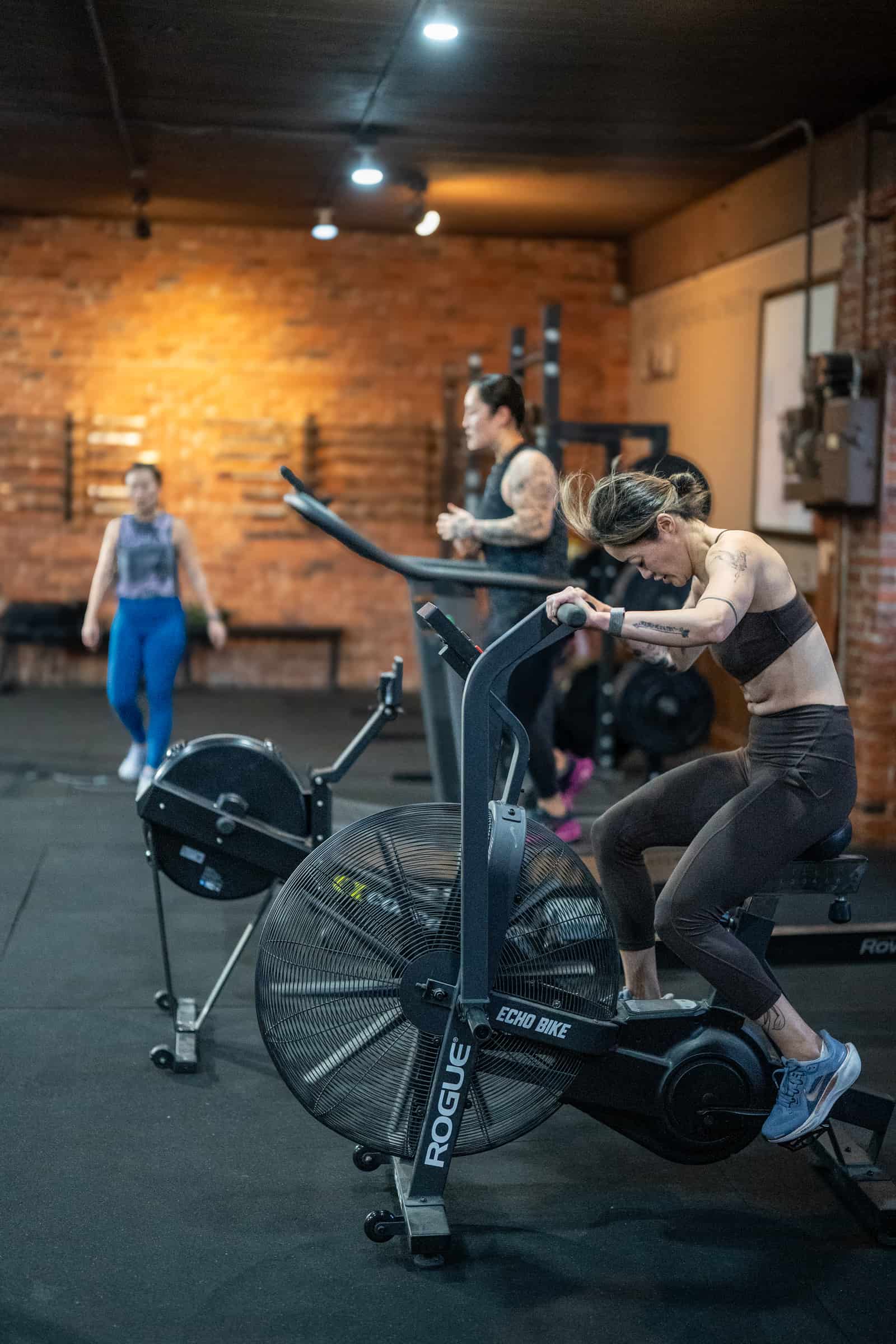
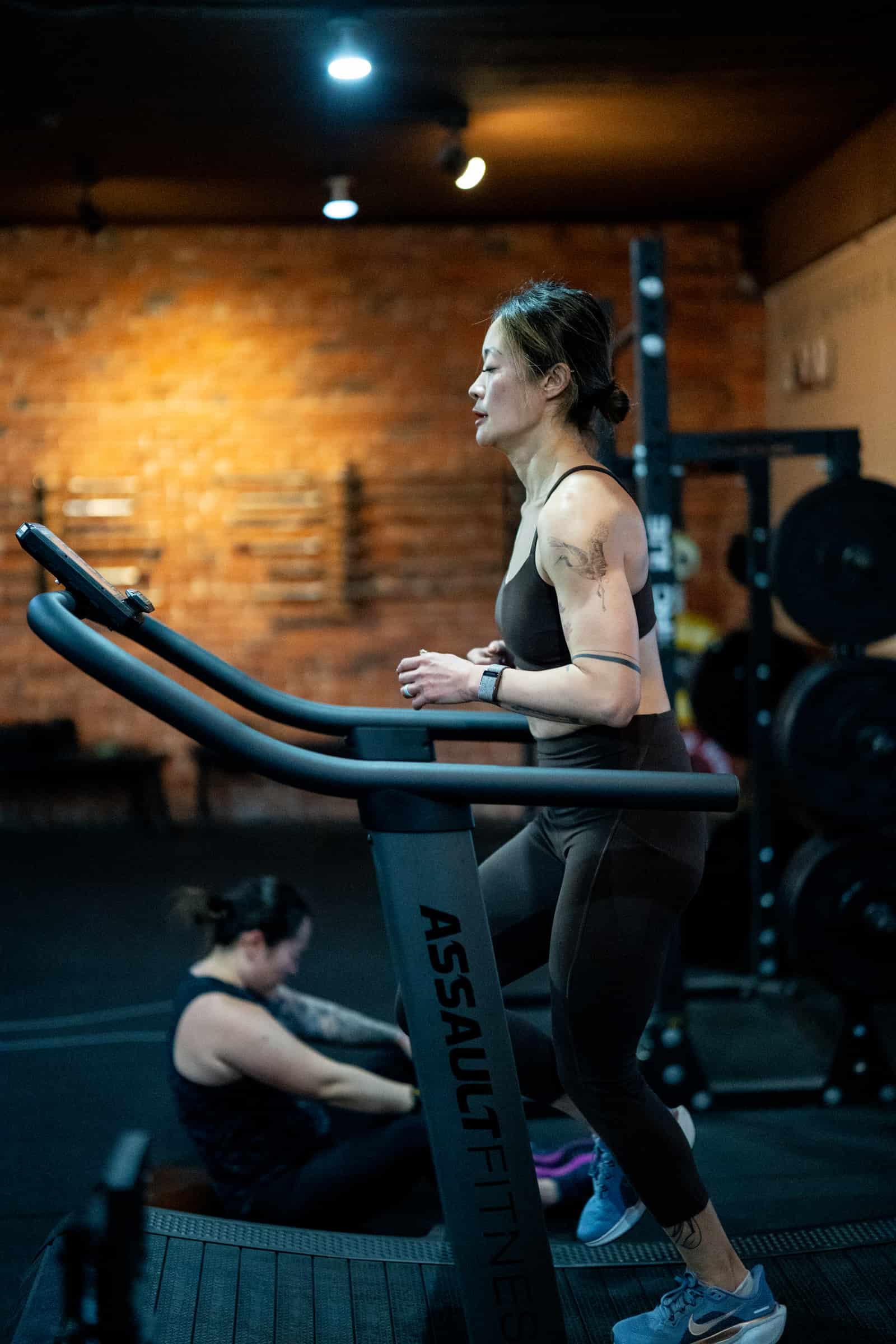
Persistence Athletics in Belltown runs a dedicated HYROX class every Saturday from 9:30 to 11 AM. It is included in every membership, and a $35 drop-in covers it too, so there is no separate HYROX price to figure out. The class rotates through all 8 stations across the month and pairs them with run intervals so members get the race format under fatigue. Most of our HYROX-prepping members attend that class plus 2 to 3 weekday classes that include station-specific work.
The biggest gap I see in athletes who train HYROX without coaching is the technique drift on stations 4 (burpee broad jumps), 7 (sandbag lunges), and 8 (wall balls). Those three are the high-rep stations where small form errors compound across hundreds of reps. With Aman, the leak was the burpee broad jump: he was popping straight up out of every burpee and then jumping flat-footed, so he was leaving a foot of distance on every rep and paying for it 60 reps in. We filmed him on a Saturday, played back the breakdown frame, and gave him one cue, load the jump out of the chest-to-floor position instead of standing first. That single fix, applied a few hundred times over a training block, was the difference between gassing out at station 4 and clearing it clean. We do the same thing for every athlete in prep: film, walk through the frame, fix the cue.
For members who want a personalized HYROX track, see our HYROX Seattle training guide. It covers race calendars, gym options across Seattle, and what to expect at your first event. Members on our group classes get HYROX-style metcons in the regular weekly programming, even outside the dedicated Saturday class.
The Saturday HYROX class also functions as a low-pressure rehearsal. Members who race for the first time in 8 weeks have already done 8 partial simulations with coaching from me, AJ, and the rest of the crew. They walk into race day knowing what each station feels like under fatigue, and that confidence is worth 30 seconds to 2 minutes of race time on its own.
Station-specific training drills you can run weekly
Pick 2 to 3 of these drills per week, rotating through stations across a 4-week block. Do not try to hit all 8 in one week.
- SkiErg endurance: 4 x 500 m at race pace, 90 seconds rest between. Work on stroke rate consistency.
- Sled push starts: 6 x 25 m sled pushes at race-load, walk back recovery. Focus on the first 5 m.
- Sled pull mechanics: 4 x 50 m sled pulls at race-load. Focus on hip hinge, not bicep pull.
- Burpee broad jump distance: 4 x 20 m burpee broad jumps for fewest reps. Goal: 2.5 m per jump.
- Row pacing: 4 x 1000 m rows at race pace. Goal: even splits across all 4 sets.
- Farmers carry grip: 4 x 100 m unbroken at race-load. Build to 200 m unbroken once weekly.
- Sandbag lunge cadence: 3 x 50 m at race-load. Count steps, aim for fewer with longer strides.
- Wall ball rhythm: 4 x 25 unbroken with a focus on catch-to-squat continuity. Build to 50 unbroken, then 75 (women) or 100 (men) before race day.
Pair each drill with the run before it. For example: 1 km run + sled push start drill, repeated 3 times. That couples the running fatigue with the station, which is closer to race demand than the drill in isolation.
The two stations that need the most rehearsal for first-time racers are burpee broad jumps and wall balls. Both are deceptively simple, both punish technique drift, and both occur near the end of the race when fatigue is highest. Practice them under accumulated fatigue at least once every 2 weeks.
Frequently Asked Questions
What are the 8 HYROX stations in order?
In order: SkiErg (1000 m), Sled Push (50 m, men 152 kg / women 102 kg), Sled Pull (50 m, men 103 kg / women 78 kg), Burpee Broad Jumps (80 m), Rowing (1000 m), Farmers Carry (200 m, men 2x24 kg / women 2x16 kg), Sandbag Lunges (100 m, men 20 kg / women 10 kg), and Wall Balls (men 100 reps at 6 kg / women 75 reps at 4 kg). A 1 km run separates each station.
Which HYROX station is the hardest?
For most first-time racers, the wall balls at station 8 are the hardest, mostly because of the cumulative fatigue. The sled push and burpee broad jumps feel hardest in the moment. The wall balls are a mental and grip-strength test after 90+ minutes of work. Train for the wall balls assuming you will arrive at them gassed.
How heavy is the HYROX sled?
Men's sled push is 152 kg total weight (sled plus plates), pulled across 50 m. Women's sled push is 102 kg. The pull is lighter (103 kg men, 78 kg women) but uses different mechanics. Sled weights and surfaces vary slightly by venue, so practice on multiple surface types if possible.
Can you skip a HYROX station?
No. All 8 stations must be completed in order before crossing the finish line. If a rep is no-repped (form breakdown), you redo it before moving on. Skipping is a DQ. Plan to complete every station, every rep, with form clean enough to count.
How long should each HYROX station take?
Targets vary by skill level. A sub-90-minute racer hits roughly: SkiErg 4:30, Sled Push 2:15, Sled Pull 2:30, Burpee Broad Jumps 4:00, Row 4:00, Farmers Carry 1:30, Sandbag Lunges 4:00, Wall Balls 5:00. Total station time around 28 minutes. Run portions take roughly 60 minutes for sub-90 finishers. Slower racers add time on stations more than runs.
Do I need to train all 8 stations or just the hardest ones?
Train all 8, with priority on the ones you are weakest at. Most first-timers underestimate the burpee broad jumps and overestimate the sled. Practice frequency: every station at least once every 2 weeks during prep, with the weakest stations 2x weekly. We rotate all 8 stations across our Saturday HYROX class at Persistence Athletics.
Try a free first class at Persistence Athletics
If you want hands-on coaching on every HYROX station, your first class at Persistence Athletics in Belltown is free and scaled to where you are, and you are welcome to attend our Saturday HYROX class as part of it. We will walk through your weakest station and give you a drill to take home, the same way we did with Aman before his first race.
Book your free class. Persistence Athletics, 3025 1st Ave, Belltown, Seattle, WA 98121. About 8 minutes on foot from Amazon, walkable from anywhere in downtown Seattle. Questions first? Call us at (206) 593-4236.
Want to take this further?
Talk to a coach about hyrox programming at Persistence Athletics.