
The MetFix Course, Now as Eight Animated Stories
MetFix explains how your metabolism makes energy and what goes wrong with it. Each of the course's eight modules now opens with a short narrated animation of its main idea, open to anyone with no login.

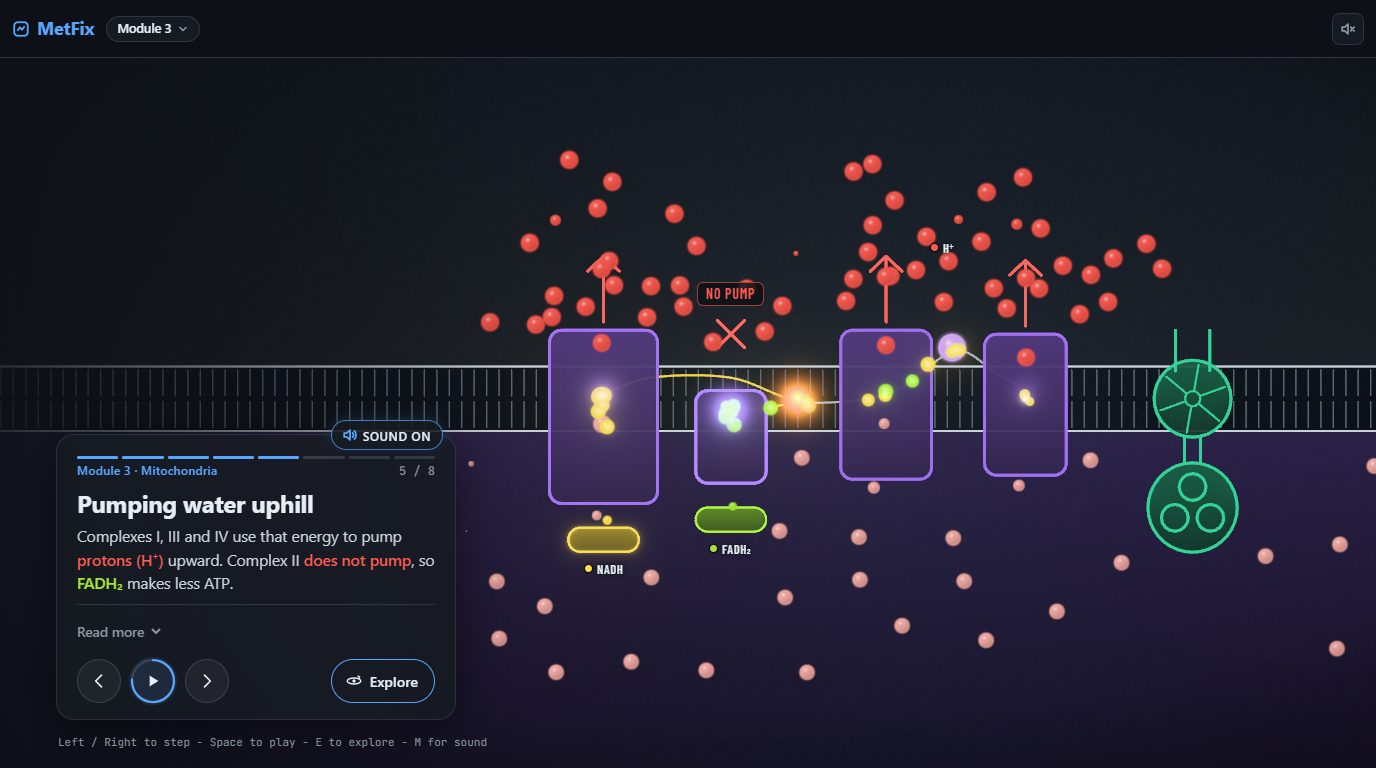
Metabolism is a moving system, and for a long time we tried to explain it with still words.
When we wrote the MetFix course, every module ran into the same problem. The ideas that matter most are things in motion. Electrons dropping down a chain of proteins. Protons piling up behind a membrane like water behind a dam. A signal that should travel from the surface of a cell to its interior and stops halfway. You can describe all of that in a paragraph, and the course does, but a paragraph asks the reader to build the moving picture in their own head. Most people, reasonably, do not.
So we built the picture.
What changed
Every one of the eight MetFix modules now opens with a short animated story of its main idea. Each story is eight short steps. A narrator walks you through it, the caption on screen carries the same idea in a sentence or two, and you can step forward and back at your own pace. When the story ends, the written module is a click away.
You can watch the whole thing at edu.metfixseattle.com/course. There is no login and no email gate. If you only have a minute, start with the course trailer, which runs the whole arc in a little over a minute.
The course in four questions
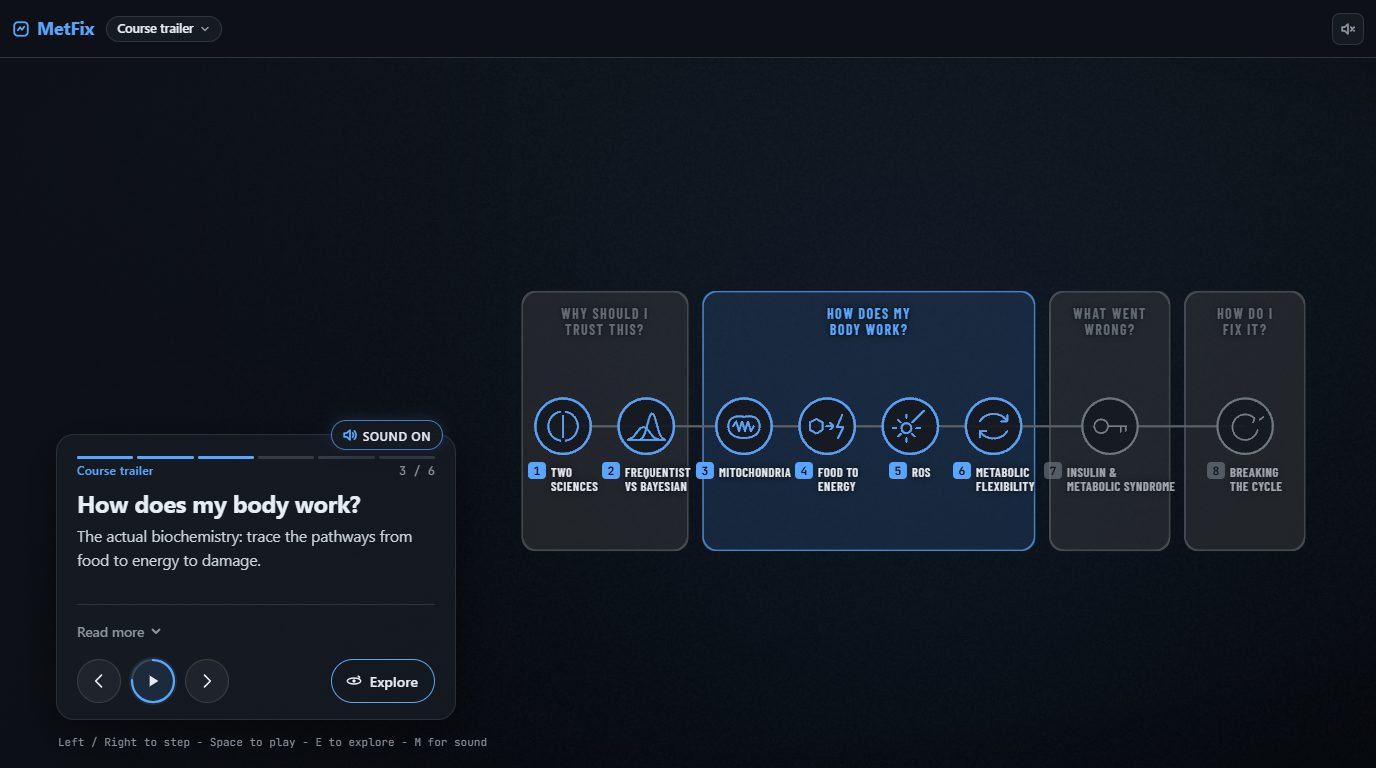
The modules are grouped the way the written course is, around four questions you would ask in this order if someone handed you a new explanation of your own metabolism.
Why should I trust this? Module 1, A Tale of Two Sciences, is about two ways of doing science: one that wants certainty and tries to disprove, and one that accepts uncertainty and judges a model by how well it predicts. Module 2, Frequentist vs Bayesian, makes that concrete with a positive test for a rare disease, and shows why a test that is "99 percent accurate" can still leave your real risk closer to 2 percent. These two come first on purpose. If you are going to change how you eat because of what a course tells you, you should know how the course decides what is true.
How does my body work? Modules 3 to 6 trace energy from food, to fuel, to damage. Module 3 is the mitochondrion and the five protein complexes that turn food energy into ATP, the molecule your cells actually spend. Module 4, From Food to Energy, follows glucose and fat until they converge on a single molecule and feed the same machinery. Module 5, Why ROS Happens, shows where reactive oxygen species, the damaging byproducts of energy production, leak out of that machinery. Module 6, Metabolic Flexibility, is about switching between burning carbohydrate and burning fat, and what it looks like when a body gets stuck on one.
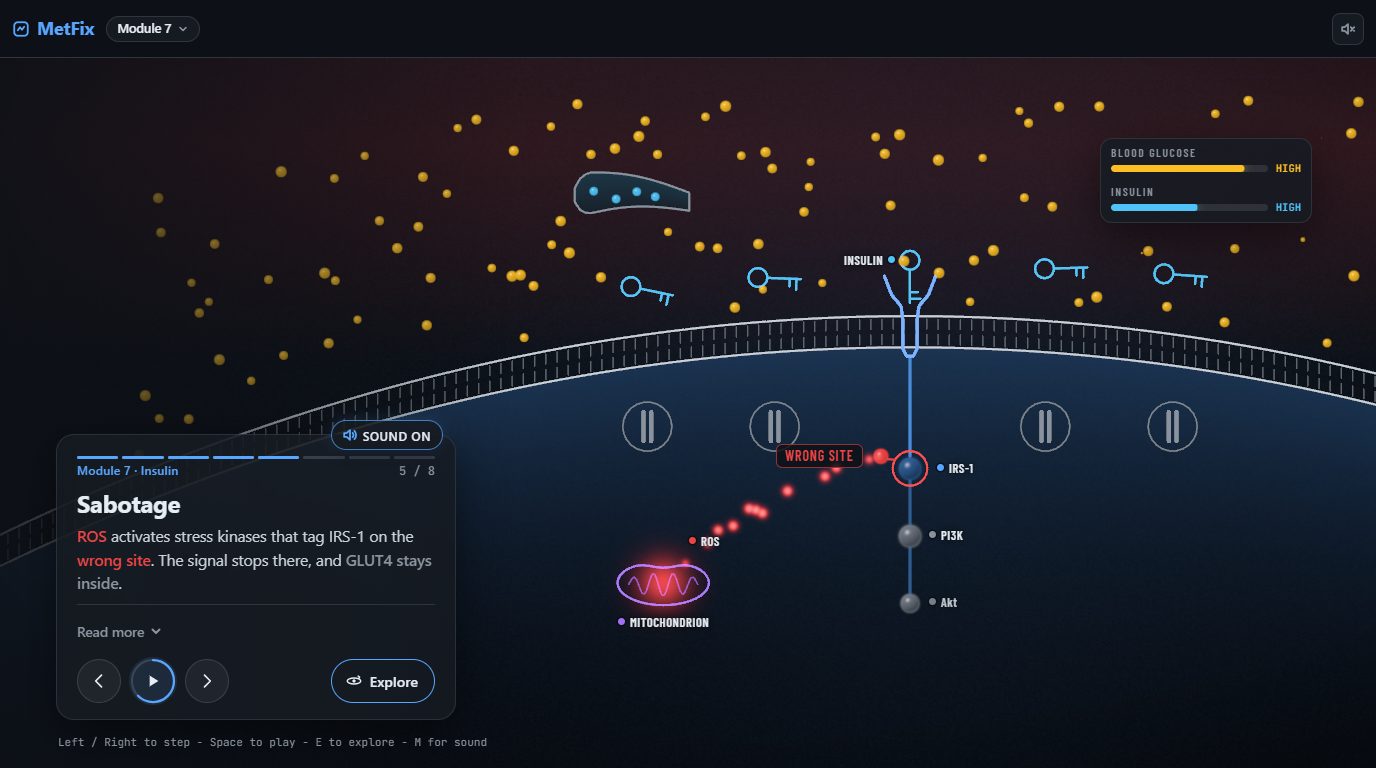
What went wrong? Module 7, Insulin, ROS and Metabolic Dysfunction, is the one I would show someone first. Insulin is a key, and a transporter called GLUT4 is the door it opens. The animation shows the signal between them being sabotaged partway down its route. The insulin is there. The receptors are there. The door still does not open. That is what insulin resistance means at the level of one cell, and it is why the pancreas responds by knocking louder.
How do I fix it? Module 8, Breaking the Cycle, shows the back door. Working muscle can bring those same glucose doors to the surface through a fuel sensor called AMPK, with no insulin required, and regular training builds more mitochondria to share the load. Then it widens out to the things that feed the cycle from outside the gym, like stress and sleep.
Why each module now starts with a bridge
The most useful feedback on the first version was that the modules felt like eight separate lectures. Each one made sense on its own, and none of them told you why you were there.
So each module now opens with a short bridge: the course map, where you have been, and what this module adds. The bridge before Module 3 zooms from a whole body down to a single cell and then to a single mitochondrion before any chemistry starts, because asking someone to care about a membrane protein before they know where it lives is asking a lot. And ROS, which the first version used across several modules without ever saying what it was, is now explained the first time it comes up.
How to watch it
It works on a phone. Turn the sound on for the narrator, or leave it off and read the captions.
You can step through with the arrows or let it play. On a computer, the left and right keys step and the space bar plays.
Each story also has an Explore button that lets you poke at the system yourself. In Module 7, for example, you can turn the ROS level up and down and change how much insulin the pancreas puts out, then watch what happens to blood glucose.
What it is, and what it is not
The animations are teaching diagrams, not microscopy. Colors, arrows and the occasional dam or delivery truck are there to make a mechanism legible, and real biology is messier than any diagram of it. The course also makes arguments, particularly in Modules 5 and 8 about which foods and habits drive the problem, and the animation presents those arguments rather than settling them.
The narrator is an AI voice reading a script we wrote from the course text. We checked every clip against its script before it went up, and the captions say the same thing in fewer words if you would rather read.
None of it is medical advice. It is an explanation of mechanisms, which is the part most people are never given, and the part that makes the advice they do get make sense. What you do about your own labs and your own medication is a conversation for your physician.
Where to go next
If you want the written version of one of these ideas, what insulin resistance actually is covers Module 7 in prose, and why moving after you eat covers the back door from Module 8. If you have ever wondered why nutrition advice seems to reverse itself every few years, why nutrition advice keeps changing is the long version of what Modules 1 and 2 are about.
And if you would rather work through it with a coach, that is what MetFix is.
- Ravi
Want to take this further?
Talk to a coach about metfix programming at Persistence Athletics.