
Gym Anxiety: A Belltown Coach's Guide for First-Timers
If you have been putting off the gym because of anxiety, this is for you. From a Belltown CrossFit coach who walks new members through it 50+ times a year.


If you are reading this at 5 AM trying to talk yourself into class, you are not alone
Most weeks at Persistence Athletics in Belltown, I meet at least one new member who admits they spent days, sometimes weeks, working up the nerve to walk through the door at 3025 1st Ave.
They tell me they have been meaning to come for months. They tried to come last week and turned around in the lobby. They felt embarrassed about how out of shape they thought they were. They were sure everyone in the class would be staring.
I tell them what I am about to tell you: this is the most common pattern I see. About 80 percent of new members were anxious before their first class. The veteran members in the room? Most of them were too. Aman came to us a sedentary software engineer who sat in his car before his first class. He is now a HYROX qualifier. We just do not talk about that part loudly.
This article is the longer version of the conversation I have at the front desk after a new member's first class. I am Jacque Dewangan, CFL3 and Precision Nutrition Level 2, head coach at Persistence. Updated June 2026.
Table of Contents
- Why gym anxiety is more common than you think
- What actually happens at a first CrossFit class
- The 5 fears, and what to do about each
- How we welcome new members at Persistence Athletics
- The 30-day path from nervous to comfortable
- Frequently Asked Questions
Why gym anxiety is more common than you think
There is a specific kind of dread that comes with starting at a new gym. It is not the same as general social anxiety. It has its own ingredients:
- Body image. Worried about how you look in workout clothes.
- Skill anxiety. Worried you will not know what the exercises are or how to do them.
- Belonging. Worried you will be the only one of your kind in the room (the only beginner, the only older person, the only person without an Amazon badge).
- Visibility. Worried that everyone is watching, judging, comparing.
These are real feelings. They are also almost always wrong about how the gym actually operates.
The reason gym anxiety is more common than gyms acknowledge is that the cure for it is the gym, but the gym is the thing causing the anxiety. The path through is short (most members tell me three classes), but the first step is the hardest. Our coach-to-athlete ratio runs about 1 to 12, which is the whole reason that first step does not leave you standing alone in a corner.
What actually happens at a first CrossFit class
Most of the fear about a first class is about the unknown. So let me describe a real first class at Persistence in concrete steps.
You arrive 15 minutes early. We greet you at the front desk, give you a quick gym tour, point out the locker room, and walk you to where the class meets. We introduce you to the coach. It might be me, or Ravi (our head S&C coach, CFL3), or AJ and the rest of the crew. The coach already knows it is your first class and has a scaled version of the workout ready.
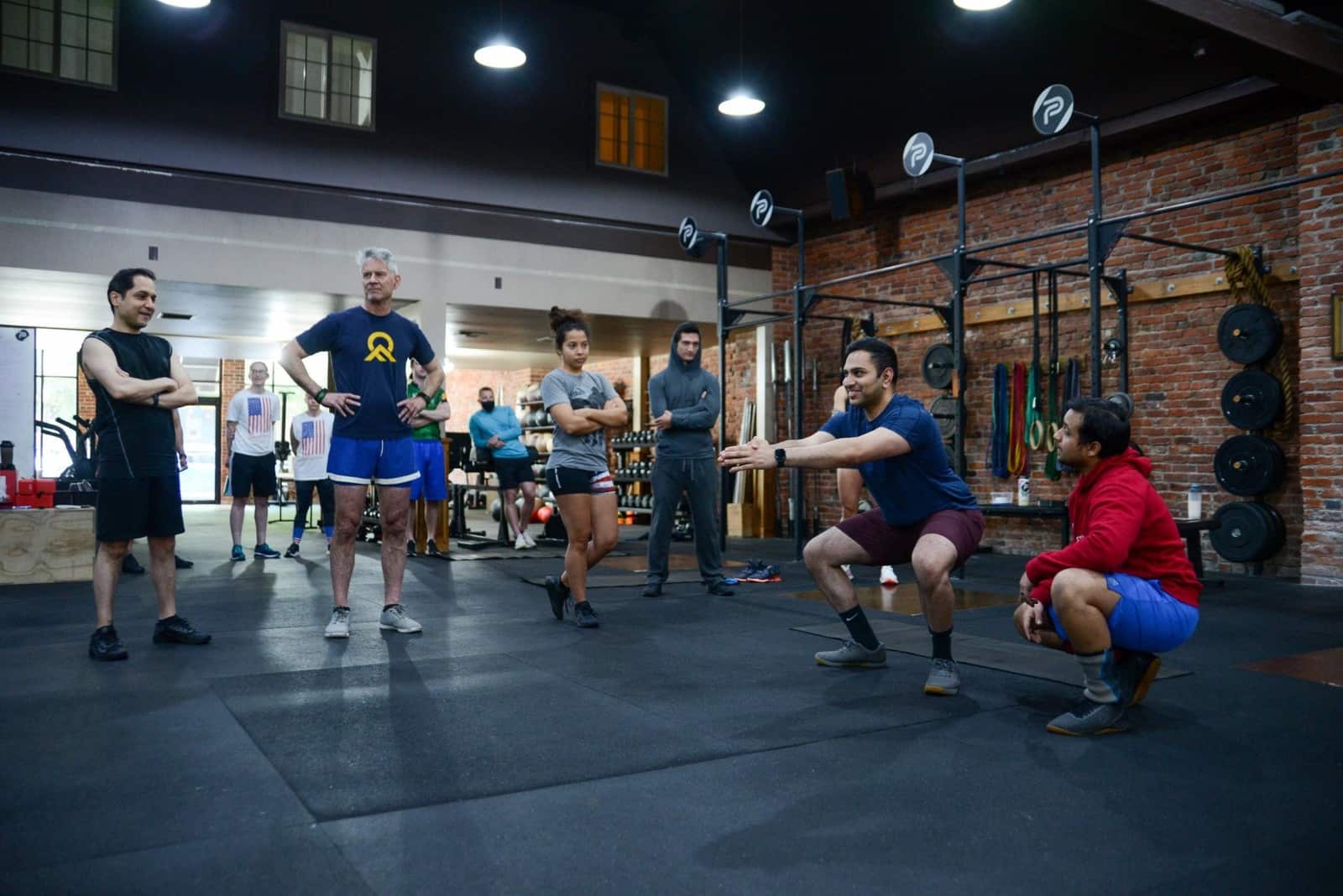
Class starts with a coach-led warm-up. Squats, hinges, light cardio. Everyone in the room is doing the same thing, including the advanced lifters who have been with us for years. The warm-up is not a test. It is a warm-up.
The strength portion comes next. The coach demonstrates the lift with light weight, breaks down the cues, and walks the room as everyone practices. For your first class, the weight will be very light. The point is to learn the pattern, not move heavy weight.
The conditioning portion (the WOD) is whatever the day's programmed workout is. The coach has scaled it for you in advance. You move through it at your pace, the coach watches your form, the rest of the class is doing their own scaled version. You finish, you cool down, you go home.
That is it. The first class is not a tryout. There is no judgment. The coach's only job is to make sure you leave better than you came in.
The 5 fears, and what to do about each
Almost every gym-anxiety conversation I have boils down to one of these five fears. Here is what to do about each.
1. "I am too out of shape to start"
The hidden assumption is that you have to get in shape before going to the gym. The opposite is true. The gym is what gets you in shape. Devang came to us as a software engineer with almost no lifting background and built his way from beginner to one of our strongest athletes over a few years and 700-plus classes. He did not earn the right to come to the gym first. He just came.
2. "I will not know what the exercises are"
This is the coach's job. Every exercise gets demonstrated and cued before you do it. You do not have to know the name of the movement. You just have to follow the demo. New members are the easiest people to coach because they have no bad habits to fix yet.
3. "Everyone will be watching me"
They will not. Most members are focused entirely on their own workout, breathing, count, or time. The only person watching you is your coach, and they are watching to help. After the first class you will realize how invisible you actually are in the room, and the relief is significant.
If a free first class still feels like too big a first step, you can book it here and tell us at the desk that you are nervous. We will pair you with a coach who walks you through every piece.
4. "I will not fit in"
Persistence has members across a 30-plus-year age range, every body type, multiple ethnicities, every fitness starting point. Tom is 66 and has logged more than 500 classes with us. Sofi came back to training postpartum and rebuilt her base step by step. We have Amazon engineers (we are about an 8-minute walk from the office), healthcare workers, new parents, and folks a year into recovery from chronic back pain. The gym is more diverse than most people assume from the outside.
5. "I will hurt myself"
Coached movement is much safer than self-coached movement. Coached gyms have lower injury rates than commercial gyms and home setups, especially for beginners. Eric came to us with chronic back pain and worked, under coaching, all the way to strict pull-ups. The whole reason you have a coach in the room is to keep you in good positions while you learn.
How we welcome new members at Persistence Athletics

Every new member at Persistence gets:
- A pre-class call or text to confirm time and answer questions.
- A 15-minute pre-class arrival to meet the coach and get the gym tour.
- A scaled version of the day's workout, built for your starting fitness level.
- A coach watching every rep of the WOD, making real-time adjustments.
- A post-class debrief at the front desk before you leave.
That whole process is intentional. We have refined it across hundreds of first classes. The point is that nobody walks in cold and feels lost. You always have a coach who knows it is your first day.
If you feel like a one-on-one start would help more, personal training for the first 4 to 8 sessions is a great option. We have several members who started with PT, built their confidence, and moved to group classes once they were comfortable. There is no wrong path.
For more on the mental side of training, our mental toughness for hybrid athletes post covers the psychological foundations once the early anxiety is past.
The 30-day path from nervous to comfortable
This is the pattern I see over and over. Of members who come to one class, about 80 percent come to a second. Of those, almost all stay through 30 days. After that, retention is over 90 percent for the first year.
What happens in 30 days:
- Day 1. You walk through the door. The hardest day.
- Day 2 to 4. You start to recognize the warm-up flow. The fear of "not knowing" drops.
- Day 5 to 10. You learn three or four names. The room stops feeling foreign.
- Day 11 to 20. You hit your first small win (a slightly heavier weight, a new movement learned). The fear of being "out of shape" gets replaced with curiosity about what comes next.
- Day 21 to 30. You start texting your friends about the gym. You become one of the people who, six months from now, tells the next nervous newcomer that everyone is too focused on their own workout to notice them.
The change is faster than you think. The hardest step is the first one. Pouria has been showing up for six-plus years and over 1,100 classes, and even he started with a Day 1. Every single one of us did.

Frequently Asked Questions
Is it normal to be nervous before my first CrossFit class?
Yes, completely. About 80 percent of new members tell me they were nervous before their first class. The pattern is so consistent that I now mention it in every intro session. Nerves usually go away by the third class once you know the routine, the coaches, and a few faces.
What if I am the only beginner in the room?
You will not be. Every Persistence class has a mix of levels. We scale every workout for new members and the coach adjusts the weight and reps so you never feel left behind. The veteran members in the room have all been you. The culture rewards showing up, not lifting heavy.
Will people stare at me if I cannot do the workout?
No. Members are focused on their own work. The only person watching closely is your coach, and they are watching to help you, not judge you. The fear of being watched is one of the most common gym-anxiety patterns and it almost never matches what actually happens in class.
Should I do personal training first to build confidence?
Some members do, especially if anxiety is severe or they have a history of injury. 4 to 8 sessions of 1-on-1 work before joining group classes is a great option. Most members do not need it. The free first class is built to be the lowest-friction entry point.
What if I have a bad first class?
Talk to the coach before you write off the gym. Often the issue is fixable: an exercise you needed scaled differently, a confusing cue, a workout that hit you wrong. We coach hundreds of first classes a year and almost every 'bad first class' was a small fix away from being a good one.
How do I stop being anxious about the gym long-term?
Three things: routine, faces, and small wins. Show up at the same class times for two weeks. Learn three names. Hit one small win (better form, one extra rep, slightly heavier weight). Once those three exist, the anxiety usually drops to background noise.
Try a free first class at Persistence Athletics
If you have been thinking about coming for weeks, this is your sign. Your first class at Persistence Athletics in Belltown is free, scaled to your starting point, and the coach already knows it is your first day. Trial-friendly times include Saturday at 8:00 AM and weekday evenings at 6:30 PM (Friday at 6:00 PM). Book your free class at 3025 1st Ave, Belltown, Seattle, walkable from anywhere in Belltown, SLU, and downtown. Questions first? Call us at (206) 593-4236.
Want to take this further?
Talk to a coach about mindset programming at Persistence Athletics.