
Deadlift Programming: Your First 12 Weeks
A 12-week deadlift program from a CFL3 coach with an MS in S&C. Specific weights, percentages, and progressions starting from a 200 lb 1RM.

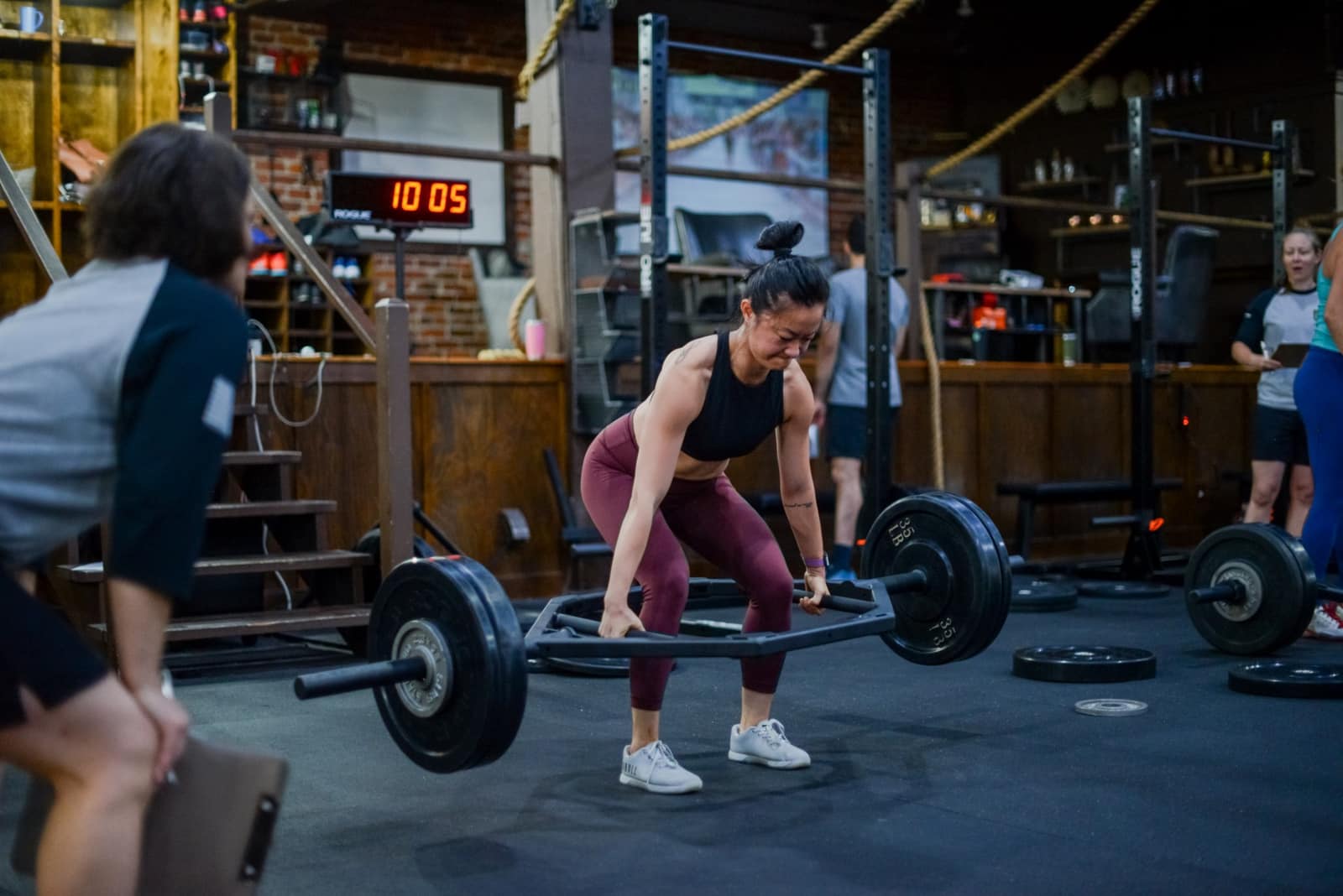
The first 12 weeks of deadlifting set the next 5 years
Most lifters get the first 12 weeks of deadlift programming wrong. They either grind through random sets at heavy weight with no structure, or they avoid the lift entirely because it feels intimidating.
The right approach is structured, progressive, and specific. I'm Ravi Dewangan, CFL3, MS in Strength and Conditioning, and CrossFit Seminar Staff. I have written and coached deadlift programs for hundreds of beginners at Persistence Athletics in Belltown. The structure below is the version I would hand any new lifter who wants to build a real deadlift in three months. Updated June 2026.
This is a 12-week beginner program with specific percentages, sample loading, and the logic behind each block. It assumes you can already perform the deadlift pattern with empty bar form (covered in our movement basics article). If the pattern is not clean yet, do 4 weeks of pattern work first.
Table of Contents
- The 3-block structure: accumulation, build, peak
- Block 1 (Weeks 1 to 4): Pattern under light load
- Block 2 (Weeks 5 to 8): Build at moderate load
- Block 3 (Weeks 9 to 12): Peak and test
- How we run deadlift programs at Persistence Athletics
- Frequently Asked Questions
The 3-block structure: accumulation, build, peak
The 12 weeks split into three 4-week blocks. Each block has a specific focus and a specific intensity range.
| Block | Weeks | Reps per set | Intensity (% of estimated 1RM) | Focus |
|---|---|---|---|---|
| 1 (Accumulation) | 1 to 4 | 5 reps | 60 to 70% | Pattern, volume, technique |
| 2 (Build) | 5 to 8 | 4 reps | 75 to 85% | Adding weight, force production |
| 3 (Peak) | 9 to 12 | 3 reps then 1 RM | 85 to 95% then test | Peak strength, max test |
The structure works because it varies volume and intensity over time. Beginners who run a single set-and-rep scheme for 12 weeks straight stall in week 6 or 7. Block periodization keeps the stimulus fresh.
The sample weights below assume a starting estimated 1RM of 200 lb. Adjust by ratio if your starting 1RM differs (multiply each weight by your_max / 200).
Block 1 (Weeks 1 to 4): Pattern under light load
Goal: build pattern fluency and accumulate volume at a load that lets you focus on technique. The bar should feel manageable on every rep. If reps 4 and 5 of any set start to break down in form, the weight is too heavy for this block.
Week 1
- Day 1: 5 sets x 5 reps at 60% of 1RM (120 lb)
- Optional Day 2 (light technique): 3 sets x 5 reps at 50% (100 lb), focus on bar path
Week 2
- Day 1: 5 sets x 5 reps at 62.5% (125 lb)
- Optional Day 2: 3 sets x 5 reps at 50% (100 lb)
Week 3
- Day 1: 5 sets x 5 reps at 65% (130 lb)
- Optional Day 2: 3 sets x 5 reps at 55% (110 lb)
Week 4
- Day 1: 5 sets x 5 reps at 67.5% (135 lb)
- Optional Day 2: 3 sets x 5 reps at 55% (110 lb)
What to focus on in Block 1
- Setup: bar over midfoot every rep, hip crease above the knee at start
- Bracing: big breath, brace before pulling slack out of the bar
- Bar path: bar travels straight up, in contact with shins
- Lockout: hips through, glutes squeezed, shoulders pulled back
- Reset between reps. No touch-and-go in this block. Every rep starts from a dead stop.
The key error to avoid: jerking the bar off the floor. The cue I use most on the floor in Belltown is "make the bar bend before it leaves the floor." Tension before motion. When Devang, one of our members, started lifting years ago, this was the single fix that changed his pull. He came in as a software engineer who had never touched a barbell, and the day he learned to pull the slack out of the bar before driving was the day his deadlift stopped looking like a scramble and started looking like a lift. He has logged over 700 classes since, and it traces back to that one cue in Block 1. This is the foundation of every heavy pull you will ever do.
Block 2 (Weeks 5 to 8): Build at moderate load
Goal: add load while preserving the technique you built in Block 1. Reps drop, weight goes up. The pattern should feel automatic by now, freeing your attention to focus on force production.
Week 5
- Day 1: 4 sets x 4 reps at 75% (150 lb)
- Optional Day 2: 3 sets x 4 reps at 60% (120 lb)
Week 6
- Day 1: 4 sets x 4 reps at 77.5% (155 lb)
- Optional Day 2: 3 sets x 4 reps at 62.5% (125 lb)
Week 7
- Day 1: 4 sets x 4 reps at 80% (160 lb)
- Optional Day 2: 3 sets x 4 reps at 65% (130 lb)
Week 8
- Day 1: 4 sets x 4 reps at 82.5% (165 lb)
- Optional Day 2: 3 sets x 4 reps at 65% (130 lb)
What to focus on in Block 2
- Speed off the floor. The bar should accelerate, not grind.
- Brace harder. The weight is heavier and the bracing demand is higher.
- Bar still in contact with shins on every rep. The bar drifting forward is the most common Block 2 error.
- Recovery: sleep 7+ hours, protein at 0.8 g/lb, deload one day before each Day 1 if you are feeling beaten up.
If you miss a rep at any point in Block 2, end the set there. Do not grind through. Failed reps in beginner programming usually mean recovery has fallen off. If you want a second set of eyes on whether a missed rep is a recovery problem or a technique problem, that is the kind of thing a coach catches in one glance on the floor. Come pull in front of one.
Block 3 (Weeks 9 to 12): Peak and test
Goal: peak strength expression and re-test the 1RM. Volume drops, intensity peaks. By the end of Week 11, your last working set will be roughly 90 percent of your starting max, with strength to spare.
Week 9
- Day 1: 3 sets x 3 reps at 85% (170 lb)
- Optional Day 2: 3 sets x 3 reps at 70% (140 lb)
Week 10
- Day 1: 3 sets x 3 reps at 87.5% (175 lb)
- Optional Day 2: 3 sets x 3 reps at 70% (140 lb)
Week 11
- Day 1: 3 sets x 2 reps at 90% (180 lb)
- Optional Day 2: 3 sets x 3 reps at 70% (140 lb)
Week 12 (Deload + Test)
- Days 1 to 3: 3 light sessions at 50 to 60 percent volume work, focus on movement quality
- Day 4 or 5: Test 1RM. Work up: 135 lb x 5, 155 x 3, 175 x 1, 195 x 1, 210 x 1 (5 percent over starting max), 220 x 1 (10 percent over).
Most beginners on this structure add 30 to 50 lb to their 1RM. Some add more. The new max becomes the basis for your next 12-week block.
What to focus on in Block 3
- Sharp setups. Heavy weight punishes sloppy setups.
- Visualize the rep before the lift. Cue yourself.
- Do not compare PRs to other lifters. Compare to your Week 1 starting weight. That is the metric that matters.
If a working set in Block 3 feels off, scale back to the previous week's weight. Better a slightly lighter session than a missed PR attempt that breaks down form.
How we run deadlift programs at Persistence Athletics
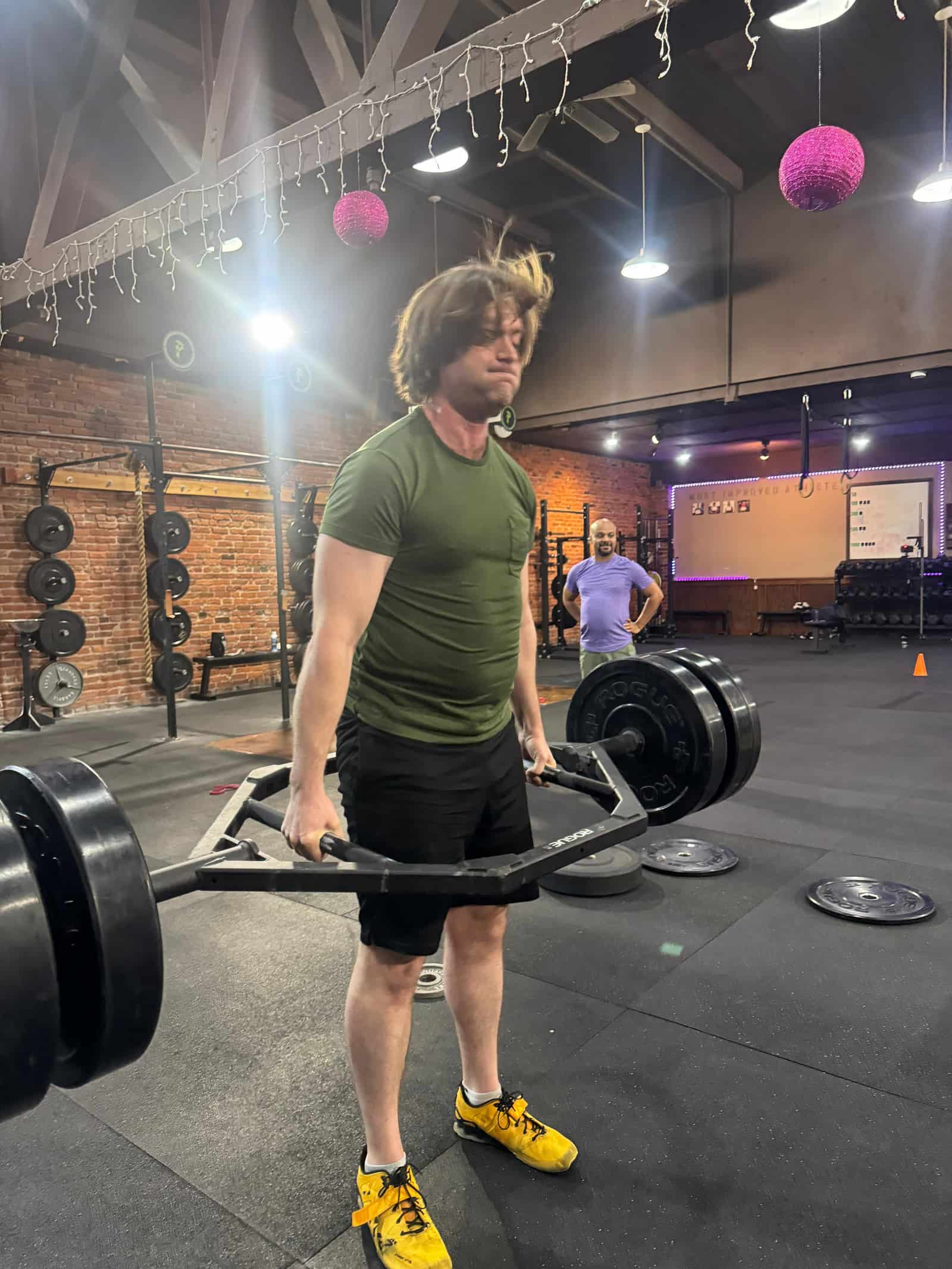
In our strength training program in Seattle, every member runs structured 12-week blocks on the deadlift, squat, and press. The structure above is a simplified version of what we run, with the sample percentages adjusted for true beginners.
In group classes, we cycle through similar block structures across the deadlift, squat, and press. Members test maxes 3 to 4 times a year. Most beginners add 100+ lb to their starting deadlift over their first year of training, which is what consistent block progression buys.
For members who want focused 1-on-1 attention, personal training for the first 8 to 12 weeks is the fastest path to a clean deadlift. One coached session a week catches every form issue before it sets. After that, group classes provide enough coaching for most lifters to keep progressing. With a coach-to-athlete ratio of roughly 1 to 12 in our group classes, you still get eyes on your setup even outside private sessions.
The deadlift specifically is one of the lifts where coaching pays the highest dividend. The margin for error is smaller than the squat, the consequences of bad form are larger, and the technique is the difference between a pull that stalls in a year and one that keeps climbing for five. The lifters at Persistence with the biggest deadlifts, Devang and Eric among them, all started with structured beginner programming and added small weight consistently for years. Neither of them walked in strong. They walked in coachable, ran the blocks, and stacked small wins until the numbers got loud. That is the entire trick, and it is boring on purpose.
Frequently Asked Questions
How often should a beginner deadlift per week?
Once a week heavy, optionally a second day at lighter load focused on technique. Twice a week of heavy deadlifting fries most beginners' recovery. Once a week with structured progression is enough to add 50 to 100 lb to a starting 1RM in 12 weeks. The deadlift is the most fatiguing of the big three lifts, and recovery limits frequency more than the lift itself.
What is a good starting deadlift weight for a beginner?
Start with the empty barbell (45 lb) for the first 1 to 2 sessions, even if you can pull more. The pattern is the priority. Once the pattern is clean, work up to a weight that allows 5 reps with perfect form. For most beginners that is 95 to 135 lb after the first 2 to 4 sessions. Forcing heavier weight before the pattern is solid is the most common deadlift mistake.
Should I deadlift sumo or conventional as a beginner?
Conventional first, for at least the first 12 weeks. Sumo has a different setup and demands different hip mobility. Most beginners do not yet have the hip mobility or pattern fluency to evaluate which stance suits them. Build a clean conventional first, then test sumo at week 13 or later if you suspect it might be a better fit.
How much weight should I add to my deadlift each week?
5 to 10 lb per week is typical for the first 12 weeks. Beginners with no prior strength training can sometimes add more. After the first 12 weeks, the rate slows to 5 lb every 2 to 3 weeks, then to 5 to 10 lb per training block. Linear weekly progression usually breaks somewhere between weeks 12 and 24.
Do I need to test my 1RM at the end of the program?
Optional. The 12-week structure builds strength whether or not you test. If you do test, do it on week 12, fresh after a deload, with a coach watching. If you skip the test, just continue into the next block at the new estimated max based on your top working set. Most beginners do not need to test maxes regularly to make progress.
What if I miss a session in the program?
Pick up where you left off. If you miss one session, just shift the calendar. If you miss a full week, repeat the previous week before continuing. Do not skip ahead to compensate. The program is built on cumulative volume and missed sessions reduce the stimulus you need.
Try a free first class at Persistence Athletics
If you want a coach to walk you through the deadlift pattern and set you up for a structured 12-week build, that is what we do. Your first class at Persistence Athletics in Belltown is free and scaled to where you are, and it includes a coached intro on the deadlift. Book your free class. Persistence Athletics, 3025 1st Ave, Belltown, Seattle, WA 98121. About 8 minutes on foot from Amazon, walkable from anywhere in downtown. Questions first? Call us at (206) 593-4236.
Want to take this further?
Talk to a coach about strength programming at Persistence Athletics.