
What Is Fitness? The Six Models We Coach From, Now Animated
Most gyms never define fitness, which is how programs drift toward whatever the coach enjoys. CrossFit's definition can be measured. Here are its six models in plain language, and an animated lesson that walks through each one.

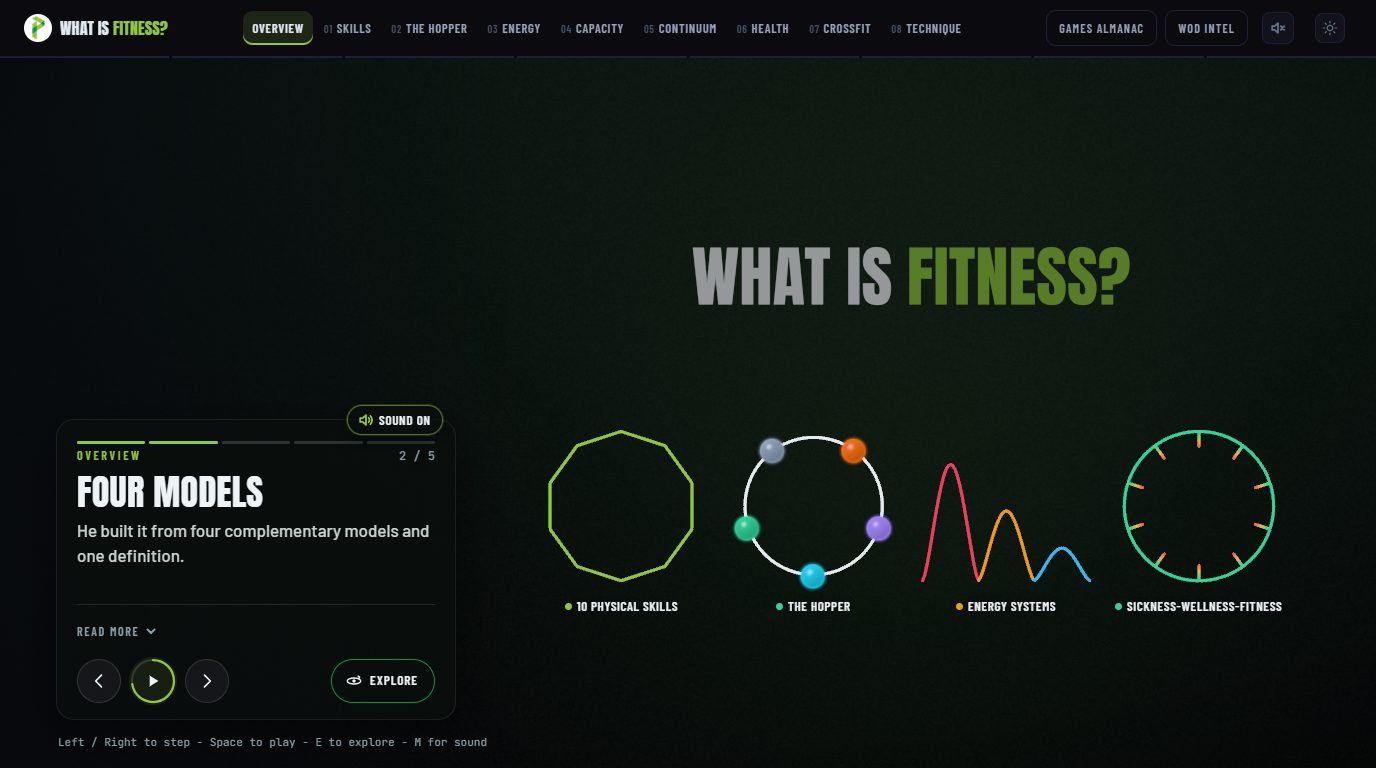
Ask ten gyms what fitness is and most of them will not answer the question. They will tell you what they do. Lifting gyms say strength. Running clubs say endurance. Yoga studios say mobility. Each answer is a description of the program, rearranged to sound like a definition.
That matters more than it sounds. If a gym never defines fitness, its program drifts toward whatever the coach enjoys, and nobody can check whether it is working.
Greg Glassman's answer, the one CrossFit is built on and the one we coach from, is unusual because you can measure it. We turned it into an animated, narrated lesson: What Is Fitness? Each chapter takes a few minutes. Here is the plain-language version of what it covers.
1. The ten physical skills
The first model is a list: cardiorespiratory endurance, stamina, strength, flexibility, power, speed, coordination, agility, balance and accuracy. You are as fit as you are competent in each of them.
Two details make the list more useful than it first looks. Some of the skills improve through training, an actual change in the body. Others improve through practice, a change in the nervous system. Power and speed come from both. And the lesson puts a balanced athlete next to twelve specialists, each with a spiky profile. The powerlifter has a towering strength score and very little metabolic capacity. That is not a criticism of powerlifting. It is a picture of what a single-quality program builds.
2. The hopper
Picture a hopper loaded with every physical task you can imagine, from a 5k run to a heavy squat to an hour of yoga, and a machine that draws tasks out at random. You get no say in what comes out. Your fitness is how well you do at whatever it is, compared with everyone else drawing from the same hopper.
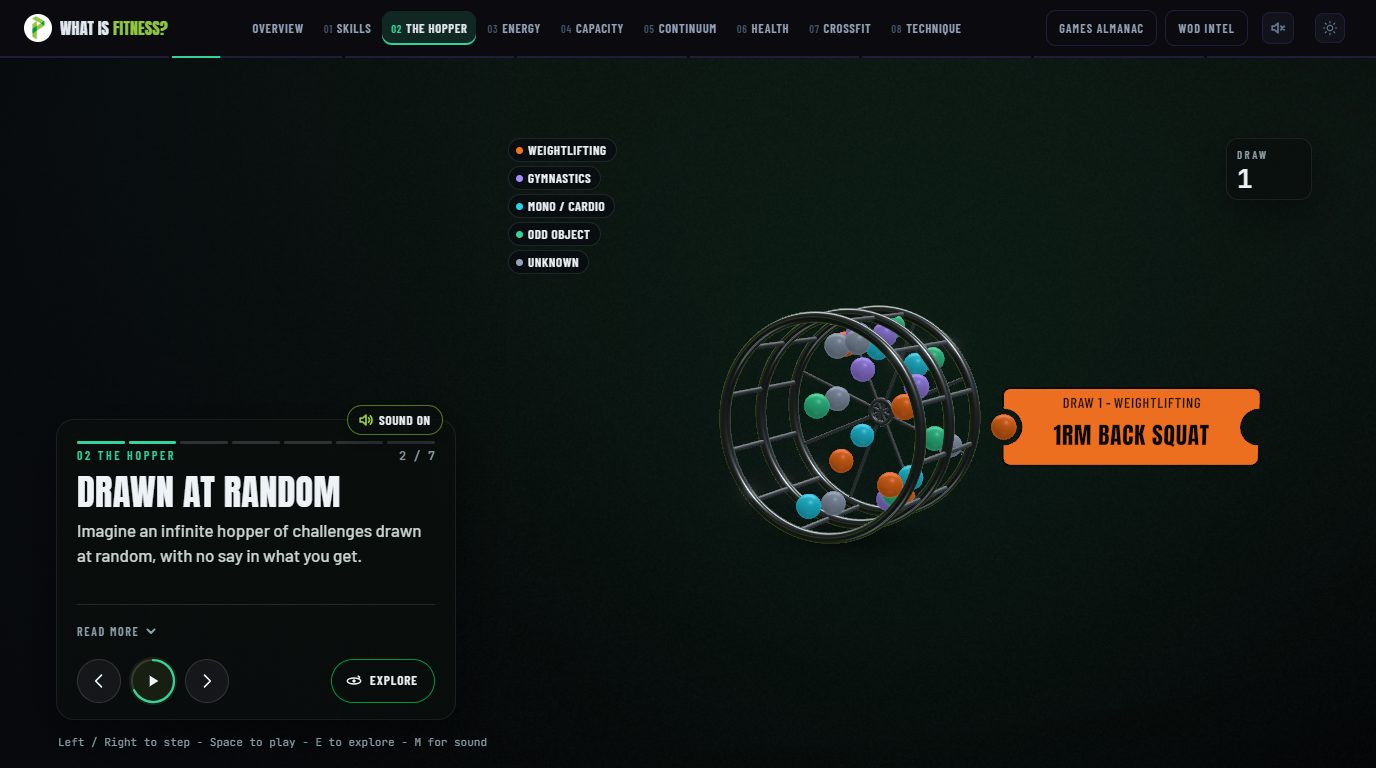
A specialist leads only while its own event keeps coming up. Keep drawing and the generalist, who is good at most things and bad at nothing, piles up the most points. That is why the workout on our board changes every day. It is not variety for entertainment. It is training for a hopper.
3. The three energy systems
Every movement you make is powered by one of three metabolic engines. The phosphagen system is explosive, and its tiny store is largely spent within ten to fifteen seconds of all-out effort. The glycolytic system takes over as that store falls and peaks somewhere around fifteen to thirty seconds. The oxidative system, which burns carbohydrate and fat with oxygen, is slow to ramp up and overtakes the other two past about seventy-five seconds.
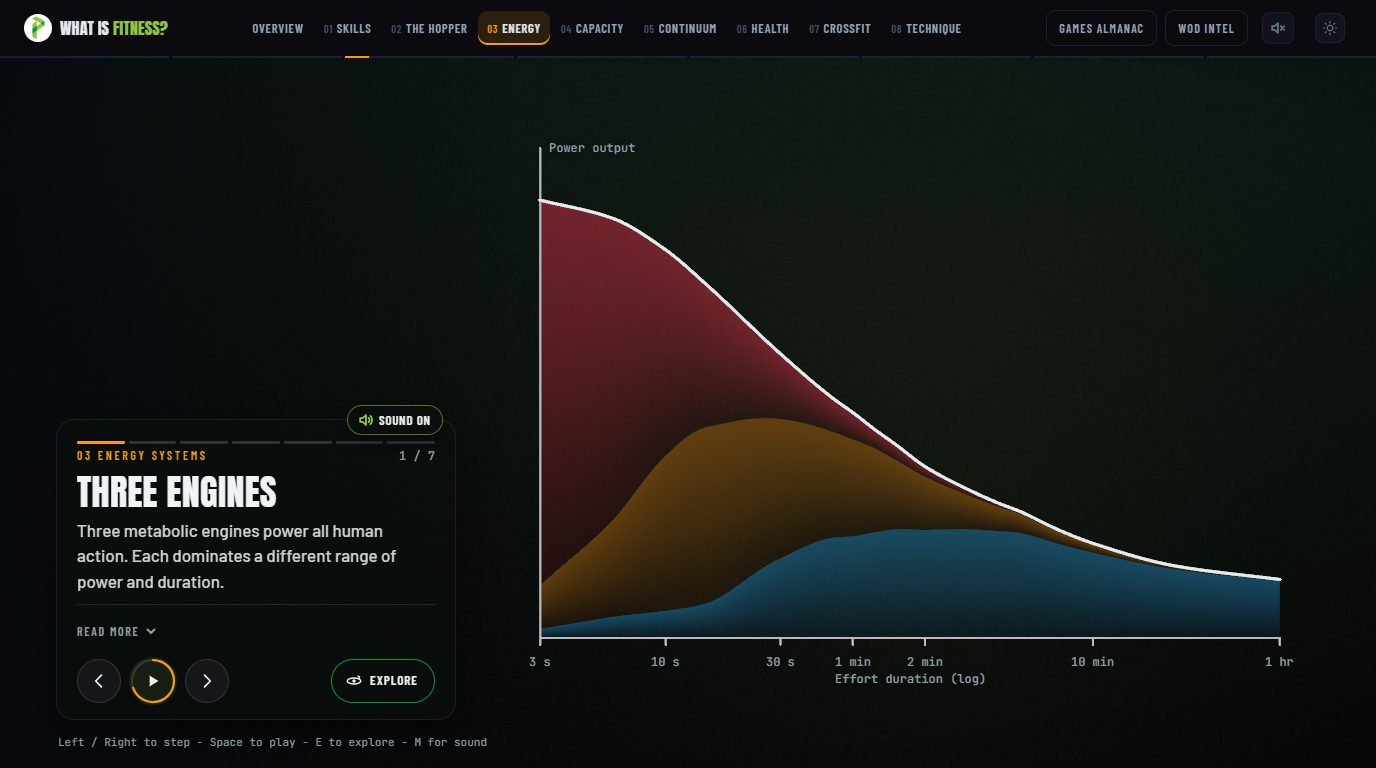
The lesson makes one point that surprises people: the oxidative engine lasts longest, but it is not the most powerful. Long and strong are different things. The model names two common faults in training: favoring one or two of these engines, and overdoing the oxidative one, the long steady kind of work, at the expense of the other two.
4. Work capacity: the definition itself
Now the definition. Power is force times distance divided by time: how much weight, how far, how fast. For any duration of effort there is a highest average power you can hold, and as the duration grows that number falls. Draw that line and you have a curve.
CrossFit adds one move: average that curve across every kind of task, every modal domain, which is where the hopper comes back in. Fitness is the area under the averaged curve. A specialist wins one point on the time axis. A generalist defends the whole curve.
This is the reason we measure things in class. The scores on the whiteboard are how you check, months later, whether the area actually grew.
5. Sickness, wellness, fitness
The fifth model takes the definition out of the gym. Nearly every measurable marker of health sits on one line running from sickness, through wellness, to fitness. In the model's own example, blood pressure of 160 over 95 is pathological, 120 over 70 is healthy, and 105 over 55 is what you see in an athlete. Body fat runs the same way. So do bone density, triglycerides and HDL.
The useful idea is that wellness is the midpoint, not the goal. Sickness, wellness and fitness are measures of the same thing, so fitness is wellness pushed further. The model's argument is that pursuing it moves every marker away from sickness at once, which makes it a hedge against disease rather than a hobby.
6. Health across a lifetime
The last model adds age. Every age of your life has its own power and duration curve. Stack them and you get a three-dimensional shape, and in this model health is the volume under it: sustained work capacity across a lifetime, not merely living a long time.
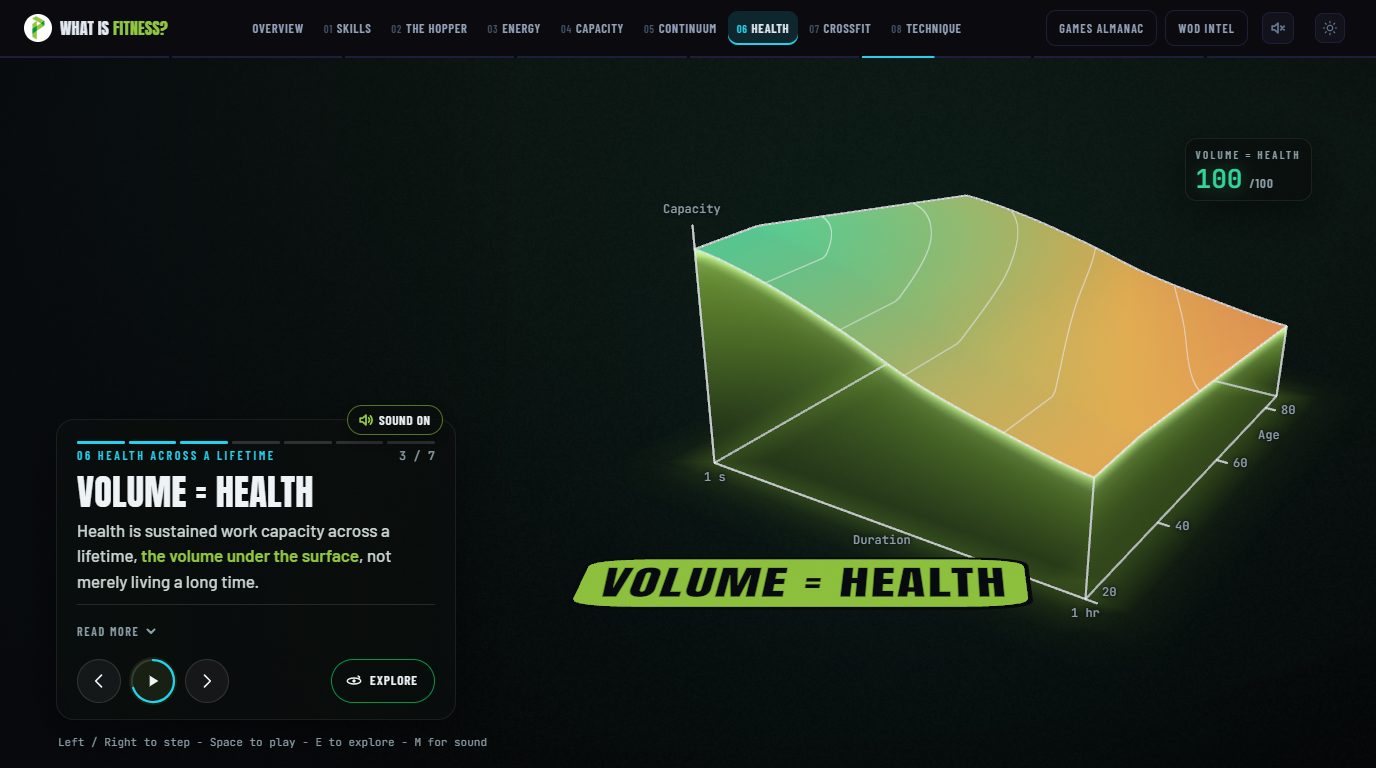
There is a line near the bottom of that shape, the independence line, below which ordinary daily tasks exceed what you can do. Stop training and the surface sinks toward it, and the power end collapses first. Start training at any age and it lifts. Resistance and power training reclaim capacity even in people in their nineties. Of everything in the lesson, that is the part I most want every new member over fifty to see.
Two new chapters: CrossFit, and technique
The lesson started with those six models. It now has two more. Chapter 07, What Is CrossFit?, takes the prescription apart word by word: constantly varied, high-intensity, functional movement, and the pyramid of development it sits on. Chapter 08, Technique, is Glassman's essay on why technique and intensity are not enemies, including the graph that defines technique and the idea of threshold training. Both deserve a post of their own, and they are getting one.
How to watch it
The lesson runs in a browser on a phone or a computer, with no login. With the sound on you get the narrator, an AI voice reading a script we wrote from the source material. With it off you get the same ideas in the captions. Step through at your own pace or let it play.
It follows Glassman's original "What Is Fitness?" article and the official CrossFit Level 1 Training Guide, and it says so on screen. We did not invent the models. We tried to draw them well.
What this has to do with your Tuesday class
If you train with us, you have been doing this all along. The program mixes lifting, gymnastics and conditioning because of the hopper. Workouts range from under a minute to well past twenty because of the energy systems. We write scores down because of the curve. And we care whether you can still pick up your grandkids at seventy-five because of the last model.
You do not need to watch any of this to get fitter. But if you are the kind of person who trains better when you know why, the lesson is here, and how our programming works covers the week-to-week side. If you have never trained with us, what to expect at your first class covers the first hour, and that first class is free.
- Ravi
Want to take this further?
Talk to a coach about crossfit programming at Persistence Athletics.