
What Actually Changes in Your Metabolism When Seattle Goes Dark, and What Does Not
The biochemistry does not have a seasonal setting. What changes when the light goes is the schedule wrapped around it: when you move, when you eat, when you sleep. The honest version, including the places where the confident advice outruns the evidence.

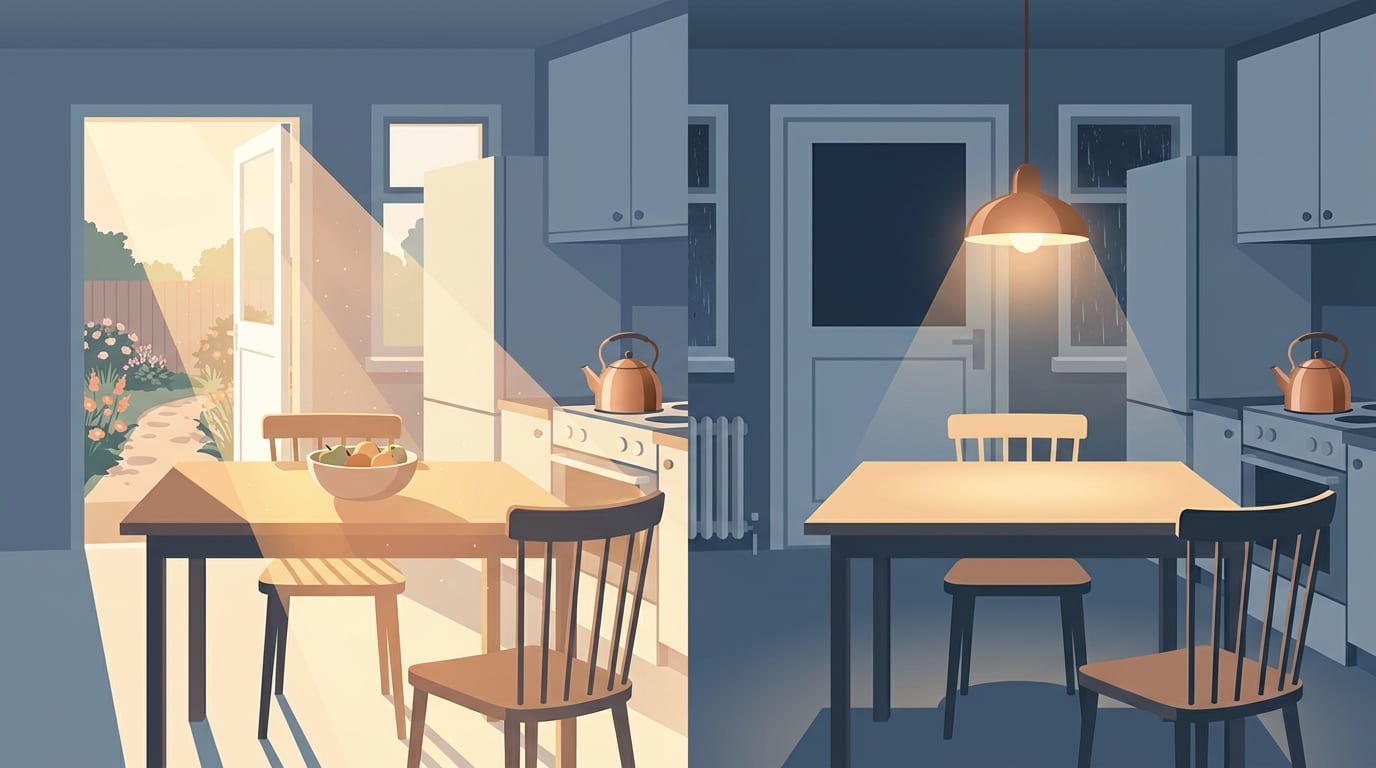
Every year around now, when the clocks are about to go back, somebody at the gym asks me some version of the same question. Does my metabolism change in winter? They have usually noticed the same thing I have, which is that the people who gain weight in Seattle tend to do it between November and February, and they want to know whether their body is doing something to them.
The honest answer has two halves, and most of what gets written about winter and metabolism only tells you one of them.
The half that does not change
Start with the machinery, because that is what most people mean when they say metabolism.
Inside every one of your cells, mitochondria take the energy in food and turn it into ATP, the molecule the cell actually spends. Insulin carries the signal that tells muscle and fat to take glucose in. A transporter called GLUT4 is the door that signal opens. A fuel sensor called AMPK opens the same door from the other side when muscle is working. None of this reads a calendar. There is no winter mode in the electron transport chain and no setting in the insulin receptor that flips when the sun sets at four twenty.
Animals that hibernate run a real seasonal program, and it is tempting to borrow it. We do not run that program. Researchers have measured resting energy use in people across seasons, and the effects they find are small, they disagree with each other about direction, and they come mostly from people exposed to real cold. A person who sleeps, works and eats in rooms held at a comfortable temperature has flattened most of whatever signal exists.
So if you gained weight last winter, it was not because your cells decided to store more in December. The chemistry that decides whether a meal is burned or stored is the same chemistry it was in July.
Three things from the course are worth carrying into the dark months because they are still true in the dark months.
The second door still works. Muscle contraction brings glucose transporters to the cell surface through a route that does not need the insulin signal at all, and that route does not care what month it is.
The window after exercise is still there. The course's figure is up to 48 hours during which muscle is refilling the fuel it used, insulin sensitivity runs higher than baseline and the glucose doors stay out longer. Tuesday's session is still working on Wednesday in January exactly as it was in June.
And the five levers are the same five levers. Food, timing, movement, sleep and stress. I ranked them by what they move for what they cost in an earlier piece, and the ranking does not have a winter edition.
The half that does change: the schedule
Here is the part the confident advice usually skips, and it is where the whole seasonal story actually lives.
The biochemistry is wrapped in a schedule. When you get light, when you move, when you eat, when you sleep. In Seattle that schedule gets rewritten every autumn without anybody deciding to rewrite it. The clocks go back on the first of November and sunset lands before five that same afternoon. By the shortest day in December there is a little over eight hours of daylight, and a lot of it is behind cloud. Most people with an office job leave home in the dark and come home in the dark for the better part of three months.
The schedule was doing far more work than anyone gives it credit for. Four pieces of it move.
Light and the clock. Your body clock is set by light, morning light most of all. One of its outputs is the daily rhythm of cortisol, which the course describes as low at night, rising before dawn, highest in the morning and falling through the day. When the morning light is weak and arrives late, the clock drifts later with it. There is a second rhythm riding on the same clock that matters more here. In controlled studies, the same meal eaten late in the evening produces a larger and longer rise in blood glucose than the identical meal eaten in the morning, because the body handles glucose less well as the day goes on. So dinner at nine after a dark commute is a different metabolic event from dinner at half past six in July, even when the plate is identical. The food did not change. The time did.
Movement goes first. This is the lever that disappears, and it disappears quietly. The walk after dinner was easy in August at eight in the evening with the sun still up. In November the same walk is dark, wet and fifty degrees, and it stops happening without a decision ever being made. The bike commute becomes a bus commute. The lunchtime loop around the block gets skipped. Nothing about the biology of movement is seasonal. Everything about whether you did it is. And because the receptive window after exercise runs a day or two, a week where the movement quietly stopped is a week spent mostly outside that window.
Sleep moves and shrinks. Dark evenings pull everything later. Dinner, screens, bed. The course's position on sleep is that it is not downtime but active metabolic reprogramming: leptin, the fullness signal, is released during sleep and ghrelin, the hunger signal, is suppressed, so tomorrow's appetite is set while you are out. Growth hormone peaks in the first three to four hours of deep sleep and shifts the body toward repairing tissue and burning fat. And the research finding the course cites, stated in general terms, is that insulin sensitivity drops by roughly a quarter to a third after a single night of short sleep. Short sleep also makes people eat more the next day, and want carbohydrate and sugar specifically. That is most of the winter cravings story, and it has nothing to do with your character. I will write about willpower, and why it is the wrong thing to blame, later this month.
Eating stretches across the whole evening. The course draws a line between the fed state, where insulin is high and the body stores, and the fasted state, where glucagon takes over and the body releases stored fuel and burns fat. The modern pattern of eating from breakfast through an evening snack keeps insulin up all day, so glucagon never really gets a turn. A dark Seattle evening is long, it is indoors, and it is where that pattern grows. Dinner drifts later and the gap between the last bite and bed gets shorter, which runs straight into the glucose rhythm above. I am not going to hand you an hour or a window. I am pointing at the mechanism so you can see what the evening is doing.
There is a fifth piece that is less about the light and more about the calendar. The dark months are also the deadline months, and the course is blunt about what stress does: cortisol is an instruction about glucose. It tells the liver to make new glucose, release stored glycogen, and blocks insulin so the glucose stays in the blood where a sprinting animal could use it. Your body cannot tell a lion from a year-end review, and only one of those involves running. Chronic stress leaves you with high cortisol and high insulin at the same time, pulling against each other, and it raises blood glucose without a single bite of food.
Where the confident advice outruns the evidence
The caption on this post promised the honest version, so here it is.
Your metabolism slows down in winter. No. See above. If someone is selling you a product to fix your winter metabolism, they are selling you a fix for a problem your cells do not have.
Seattle makes no vitamin D from October to March. This one is usually a borrowed number. The measured anchors are Boston, where skin makes essentially no vitamin D from winter sun for a few months around the solstice, and Edmonton, much farther north, where the gap runs from roughly October to March. Seattle sits between the two in latitude, and then our cloud sits on top of that. So the gap is real, it is long, and the exact months are not something I can quote for our city with a straight face. Low vitamin D does travel with metabolic dysfunction in population data. But when researchers ran a large trial giving vitamin D to people at high risk of type 2 diabetes who were not deficient, it did not prevent the diabetes it was designed to prevent. So it is a marker worth knowing about, not a lever we have watched move the outcome. Whether you should test or take it is a conversation with your physician, and we do not publish doses.
A light box fixes it. Bright light in the morning has reasonable evidence for seasonal low mood and a sensible mechanism for anchoring the clock. That is a schedule tool, and a useful one for some people. The metabolic claims attached to it are thin.
Cold plunges burn fat. Cold exposure does activate brown fat, which burns fuel to make heat, and the mechanism is real. The energy involved is small, and nobody has shown that it changes where an indoor Seattle winter ends up. Enjoy the plunge if you enjoy the plunge. Do not file it under metabolism.
Winter cravings are a willpower problem. They are mostly a sleep problem, with a clock problem underneath. The course notes that short sleep weakens the part of the brain that does restraint while making the part that reacts more reactive. Blaming yourself for that is like blaming yourself for being tired after a red-eye.
What we actually do about it
Protect the schedule, not the chemistry. That is the whole plan, and it is why a gym is a reasonable answer to a question about darkness.
Get light early where you can. Walk to the bus instead of driving to it, take the coffee outside, sit by the window. It is not a cure for anything, it is the cheapest way to tell your clock what time it is.
Put movement on the calendar in a lit, warm room with other people in it, because the version that depends on the weather is the version that quietly stops. That is a large part of what our 5pm and 6:30pm classes are for in November. The programming is the same as it is in June. The point is that it happens.
Keep dinner where it was in July if you can, and keep the wake time steady even when the evenings are not. Both are schedule decisions and both land directly on the mechanisms above.
Be suspicious of anything with the word winter in the product name.
If you are tired all the time right now and wondering whether that is the season too, the tired-all-the-time problem is usually an engine problem, and the engine does not know the date either.
None of this is medical advice, and none of it is about you specifically. If you have a diagnosis, take medication that affects blood sugar or sleep, or have a history that makes any of this a medical question, bring it to your physician. That is the right place for it.
The short version
Your metabolism does not have a seasonal setting. The machinery that burns and stores is the same in January as in July, the second door into the muscle cell still opens without insulin, and the window after exercise is still a day or two long.
What changes when Seattle goes dark is the schedule wrapped around that machinery. Movement drops out first, sleep moves later and gets shorter, eating spreads across a long indoor evening, and all of it lands on a body clock that was already drifting. Those are the inputs, and the inputs were doing more work than anyone gave them credit for.
If you want the signalling side of the story, what insulin resistance actually is covers it. If you would rather work on your own schedule with a coach, that is what MetFix is.
- Ravi
Want to take this further?
Talk to a coach about metfix programming at Persistence Athletics.