
Move Well or Move Fast? Why CrossFit Says That Is the Wrong Question
Greg Glassman's essay on technique argues that choosing between good form and speed is a false choice. Here is his case in plain language: what technique is, what a deviation is, why mechanics come first, and what threshold training means.

Every coach has heard the question in some form. Should I slow down and get it right, or go fast for the score?
Greg Glassman wrote an essay arguing that the question itself is the mistake. It is one of the shorter pieces in the CrossFit Level 1 Training Guide and one of the most practical, and nearly all of it applies to every class we run. We built the last chapter of our animated lesson around it: Technique. This post makes the same argument in writing, in the order the essay makes it.
How to judge a program
The essay opens with three words for judging any training program: safety, efficacy and efficiency. Efficacy is the return, how much fitter you get. Efficiency is the rate, how quickly you get it. Safety is how many people make it to the finish line rather than dropping out along the way.
All three point the same way, toward better results for more people. They also trade off against each other. Push intensity and you can compromise safety. Lose people to injury and you damage efficacy, because an injured athlete is not getting fitter. Technique, the essay argues, sits at the heart of all three.
What technique is, exactly
Once fitness is measured as work capacity, how you move starts to matter, and the essay separates four words people use interchangeably. Mechanics is the physics. Technique is the method. Form is the standard, judged good or bad. Style is a personal signature, which can vary from person to person without anything being wrong.
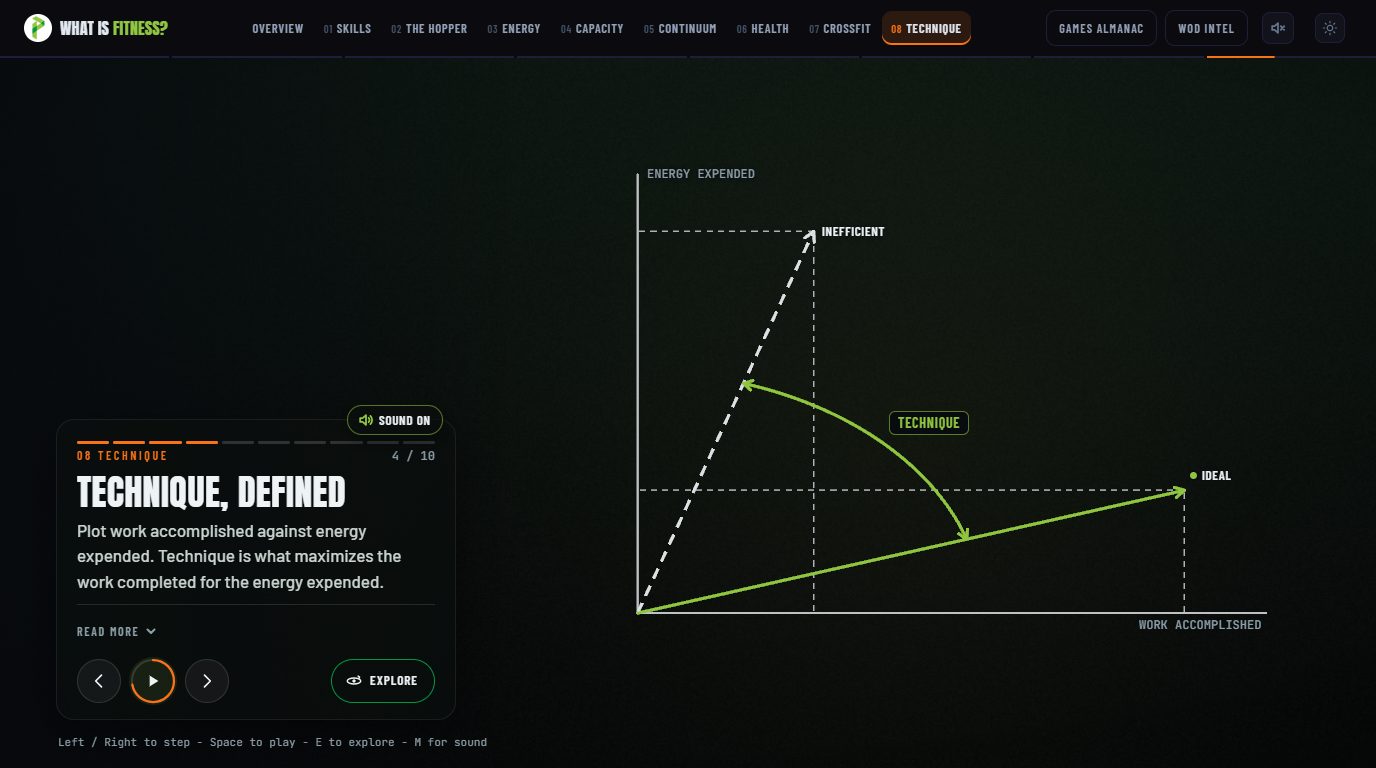
Then it defines technique with a graph. Plot the work you accomplish against the energy you spend. For any movement, the technique that gets the most work done for the energy spent is the best technique. That is the whole definition. It is not about looking pretty. It is about getting the most done for what it costs you.
What a deviation is
A deviation is movement that form judges bad, and the essay's example is deliberately ordinary. Two people lift the same heavy object off the ground. One pops the hip and gets under it. The other pulls with a rounded back.
The second person might still get the object up. It is still the deviation, and the cost is safety: pulling a heavy load with a rounded back is how backs get hurt. To stay safe, use good form. It is the least surprising sentence in the essay, and everything after it depends on it.
The charter: mechanics, consistency, then intensity
The rule that follows is what CrossFit calls the charter. Learn the mechanics first. Then show you can reproduce them consistently. Then, and only then, add intensity. The essay is blunt that ignoring this order increases the risk of injury, especially under load.
You have seen this if you have taken a class with us. It is why new members spend their first weeks with lighter loads, more coaching and less encouragement to go faster, and it is most of what is CrossFit safe? is about.
Speed is not the enemy
This is where the essay turns, and where it gets interesting. Having put mechanics first, Glassman refuses to conclude that slower is better.
His examples are skills where proficiency and speed are the same thing: typing, shooting, playing the violin, motor racing. Nobody hires a typist who manages twenty words a minute, however accurate they are. In his words, "a perfectly exquisite Fran is worthless if it takes 32 minutes." The choice between good form and going fast is an illusion. Technique and speed are not at odds.
Threshold training
So how do you get faster without falling apart? The essay's answer is threshold training.
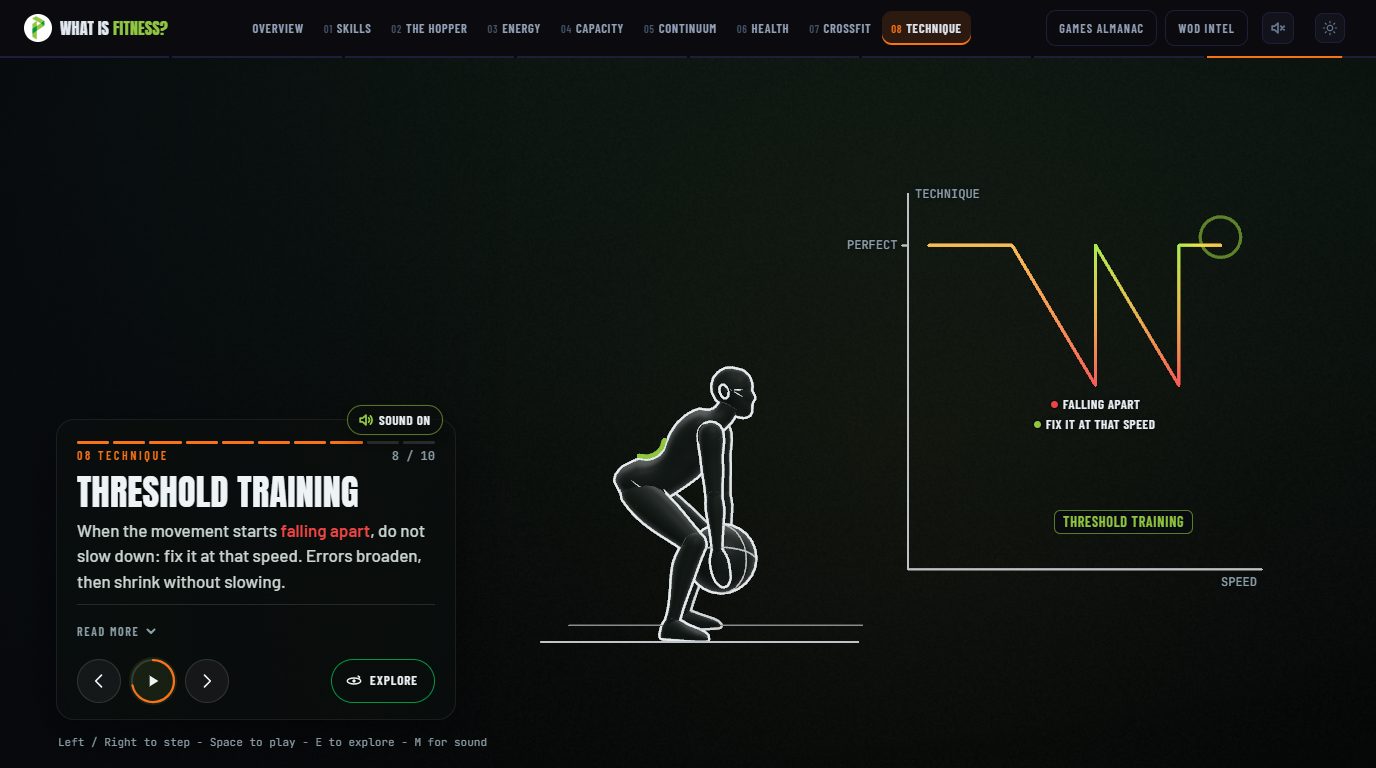
Speed is learned through errors. If your technique is perfect every rep, your intensity is low, because you are nowhere near your limit. As you push the speed, errors appear and spread. They are not a sign that something has gone wrong. They are an unavoidable part of getting better. Threshold training is what you do at that point: you do not slow down, you fix the movement at that speed. The errors narrow again without the speed dropping.
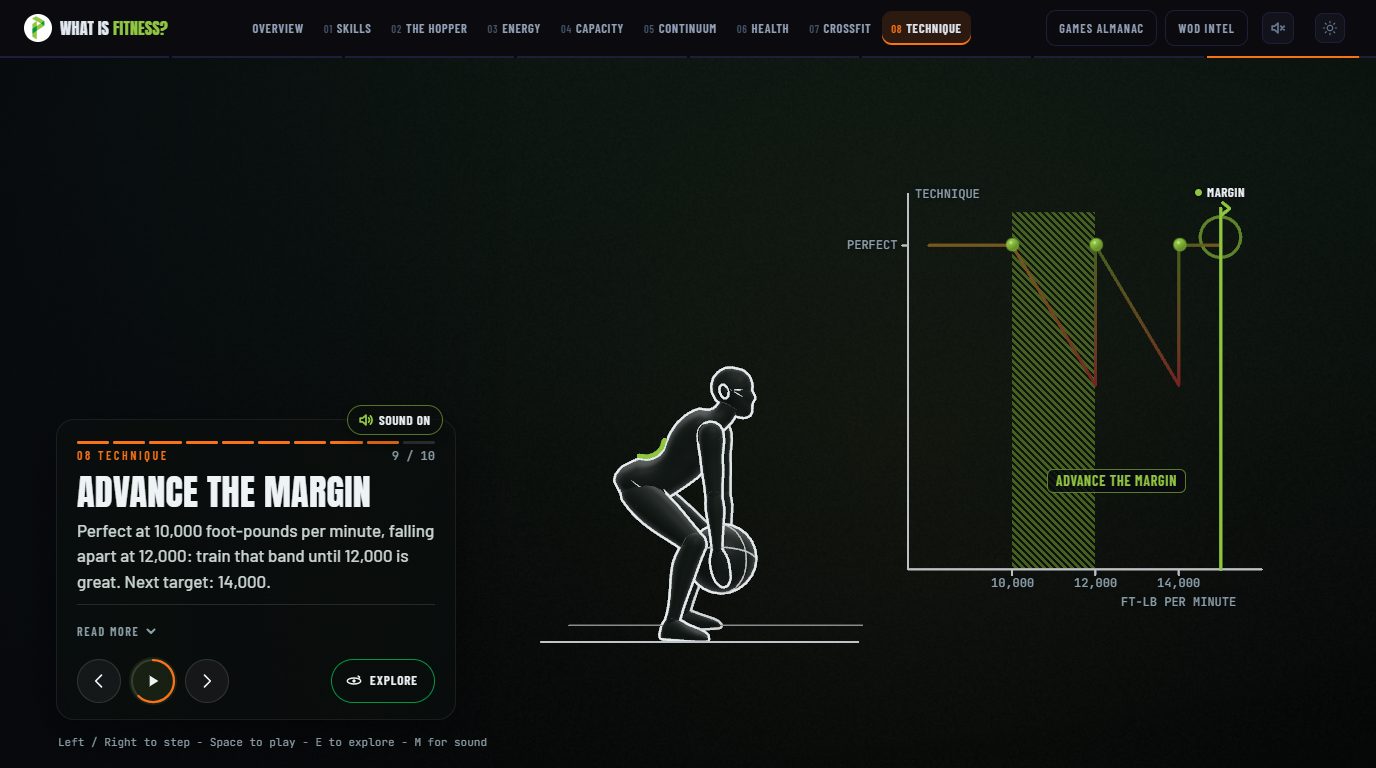
The essay puts numbers on it. Say an athlete moves perfectly at 10,000 foot-pounds per minute and starts falling apart at 12,000. Train in that band, between perfect and falling apart, until 12,000 looks great. Then the next target is 14,000. The margin moves up.
The part that needs a coach
Read quickly, threshold training can sound like it contradicts the charter. It can also sound like it contradicts what I wrote about continuing after form has broken down just because the clock is still running. It does not contradict either, and the difference is the coach.
Here is how we apply it. Threshold work is not grinding out broken reps because the clock is running. It is working at the edge of your technique on movements you already own, while someone watches and corrects the fault as it appears, at loads where a fault is a teaching moment rather than an injury. When the fault cannot be fixed at that speed, the weight comes down. The charter still holds. Mechanics and consistency come first, and threshold training is what intensity looks like once they are in place.
If you want to see the same thinking applied to one lift, the most common squat form mistakes is a good place to start.
Technique is everything
The essay closes by returning to the graph. Without technique you will not express power in any meaningful amount, or be safe trying. Technique is not a separate concern that competes with safety, efficacy and efficiency. It is part of all three.
The chapter is here. It takes a few minutes, and the narrator is an AI voice reading a script we wrote from the essay, so the captions say the same thing if you would rather read. It is the eighth chapter of the lesson, so if you want the ground it stands on, what is fitness? and what is CrossFit? come first. And if you want to work on yours with a coach watching, your first class is free.
- Ravi
Want to take this further?
Talk to a coach about crossfit programming at Persistence Athletics.