
What Is CrossFit? The Prescription, Taken Apart Word by Word
CrossFit is defined in one sentence: constantly varied, high-intensity, functional movement. Every word in it is doing a specific job. Here is what each one means, why the order of development matters, and an animated chapter that shows it.


CrossFit has a one-sentence definition, and most people who do CrossFit could not tell you what it is. That is a shame, because the sentence is unusually precise. Every word in it was chosen to rule something out.
The sentence is: constantly varied, high-intensity, functional movement. The stated aim is to prepare you for the unknown and the unknowable, which sounds grand until you notice that it is just a description of ordinary life.
We built a chapter of our animated lesson around it, What Is CrossFit? This post covers the same ground in writing, word by word.
Functional: movements from life
Start with the noun. A squat is standing up from a seat. A deadlift is picking any object up off the ground. Neither was invented in a gym. They are movements you already do every day, loaded and practiced so you do them well.
Both also move many joints at once, which is the other half of what functional means here. Traditional gym programs lean on isolation exercises that work one joint at a time. CrossFit swapped them out: the lateral raise for the push press, the curl for the pull-up, the leg extension for the squat. Each swap trades an exercise that trains a muscle for a movement that trains a task.
High intensity: intensity is power

Intensity is the most misunderstood word in the sentence, because people hear it as "how much it hurts". In CrossFit, intensity means power: work divided by time. It is the variable most closely tied to how much you adapt.
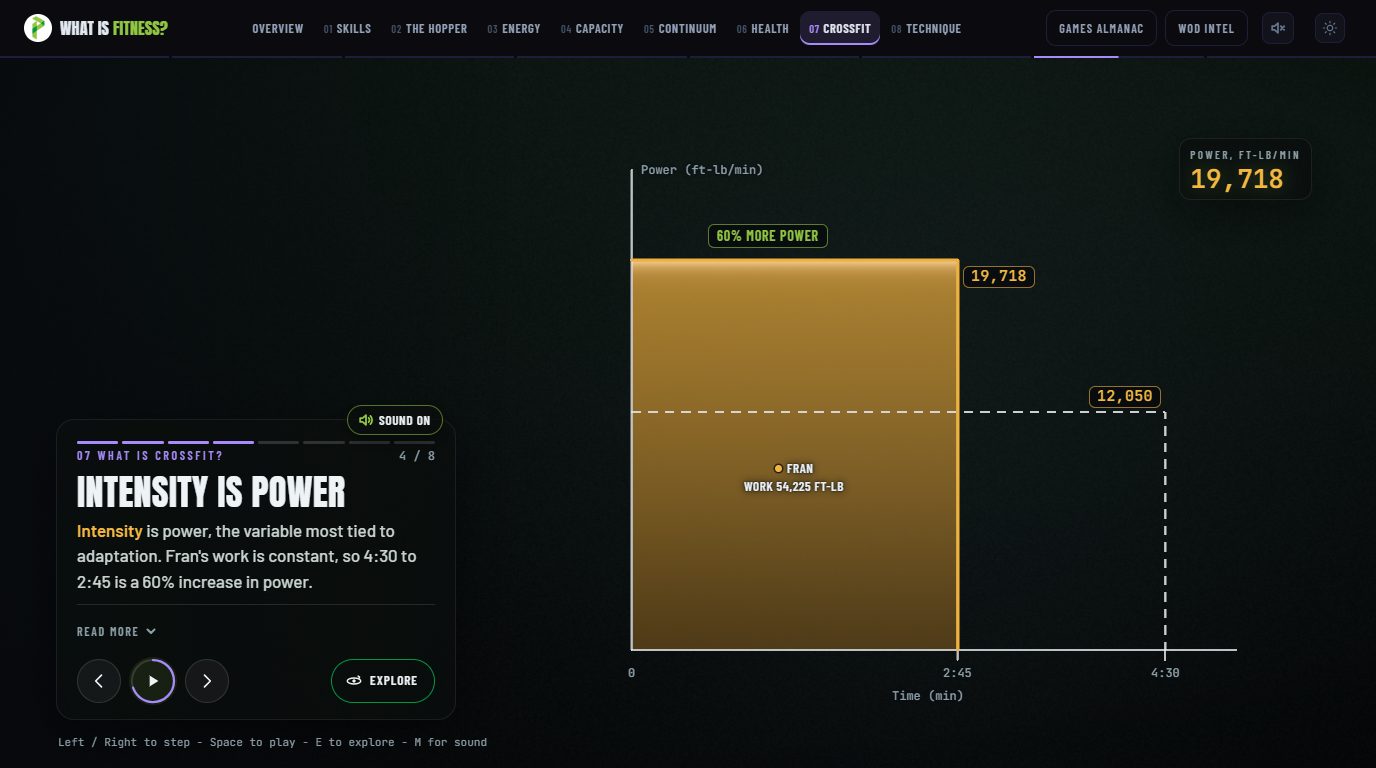
The lesson uses Fran, a benchmark of thrusters and pull-ups, to make the point. The work in Fran never changes: the same bar, moved the same distance, the same number of times. So if an athlete's time drops from 4:30 to 2:45, the only thing that changed is the rate. The same work in about three fifths of the time is a large jump in power, and the Level 1 guide works the full calculation through for a six-foot, 200-pound athlete.
This is also why we scale. Intensity is your power output, so the right version of a workout is the one you can do fast and well, not the one with the biggest number on the bar.
Constantly varied: routine is the enemy
The lesson borrows an example from the guide. A cyclist who only ever rides between five and seven miles gets very good at five to seven miles, and tests weak below five and above seven. Train a narrow band and you are fit for a narrow band.
Varied training widens the margins. That is all "constantly varied" means. It is not randomness for its own sake, and it is not the absence of a plan. Our programming has a structure, which we have written about separately, and inside that structure the stimulus keeps moving so that no single band gets all the attention.
The pyramid underneath it
The second half of the chapter is a pyramid: CrossFit's theoretical hierarchy of development. From the bottom up, it runs nutrition, then metabolic conditioning, then gymnastics, then weightlifting and throwing, and sport at the top. The guide describes it as running from molecules to mastery.
The pyramid makes one claim worth sitting with. Nobody sets out to train these components in a particular order, but nature imposes one anyway: a deficiency at one level makes every level above it suffer. An athlete with excellent barbell technique and poor conditioning will not show that technique in the eleventh round. An athlete who trains beautifully and eats badly is building on the weakest layer.
This is why we talk about food in a gym. It is the base of the pyramid, not a side topic, and it is why MetFix exists alongside the classes.
Fitness in 100 words
The chapter ends on Glassman's "Fitness in 100 Words", a single paragraph that compresses everything above into instructions. It opens with what to eat and closes with learning and playing new sports. In between: lift, master the basics of gymnastics, bike, run, swim and row hard and fast, mix those elements in as many combinations as you can think of, and keep the workouts short and intense.
It is the most-quoted paragraph in CrossFit for good reason. It is also a reasonable checklist for any program, ours included. Read it against your current training and see which lines you are skipping.
What CrossFit is not
Taking the sentence apart also clears up three common misreadings.
It is not random. Constantly varied describes the stimulus, not the planning. A coach who writes workouts by pulling movements out of a hat is not doing CrossFit more faithfully, just less carefully.
It is not the CrossFit Games. The Games are a sport, and sport sits at the top of the pyramid. The methodology underneath is general physical preparation for ordinary people, and almost nobody in a typical class, ours included, is training to compete. If you are curious about competing anyway, should you compete? is the honest version of that conversation.
It is not maximum effort every day. Intensity is power, and power is relative to what you can sustain with good movement. A session done at a pace you can hold well is more intense, in the sense that matters, than one where you blew up in the first two minutes and walked the rest.
What it looks like in a class
In practice, all of this shows up as one thing. The workout on the board is the same for everyone, and the version each person does is not. Load, range, reps and movement substitutions change so that a new member and someone ten years in get the same stimulus.
If you are wondering whether that includes you, is CrossFit safe? is the honest version of that conversation, and what is fitness? covers the definition this prescription is built to serve.
The chapter itself is here. It takes a few minutes, it works on a phone, and the narrator is an AI voice reading a script we wrote from the Level 1 guide, so the captions carry the same ideas if you would rather read. And if you would rather find out the other way, your first class is free.
- Ravi
Want to take this further?
Talk to a coach about crossfit programming at Persistence Athletics.